21st-century market competition is exceedingly high. Even a single instance of unexpected downtime can set your business back significantly.
Root Cause Analysis (RCA) is one such way to inhibit this downtime by identifying the root cause of any system failure and mitigating it proactively. It has emerged as a foremost technique for engineers in reliability engineering services to address these challenges and assist businesses to remain competitive and expand their success network.
In this blog, we’ll delve further into this technique, know its working methods, and unfold some useful tools and techniques that will help to cultivate the best from your task operations.
Root Cause Analysis (RCA): Understanding the Definition
As the name states, Root Cause Analysis (RCA) is a systematic approach that targets the root cause of the problem. It analyzes all the details behind that cause and the causal factors leading to these causes. It is an essential component of system reliability engineering where engineers not just target that problem but find innovative ways to ensure it won’t repeat again.
For example, in an automobile engine manufacturing process, the production team is facing overheating issues in their IC engines. The reliability engineering service provider arrives and, rather than fixing the overheating problem, explores deeper into why the problem has surfaced. In this case, the main cause of the problem was the mistimed exhaust valve.
If we consider only minimizing the overheating issue, we would increase the coolant flow or add additional cooling measures to reduce the temperature temporarily. But since we investigated it deeply by correcting the timing of the valve, we have not just fixed the problem but also prevented it from happening in the future, ultimately leading to reduced downtime and unnecessary repair costs.
How Does the Root Cause Analysis Process Work?
Root Cause Analysis works on a simple concept of Exploratory Data Analysis (EDA) by covering all the lifecycles of analysis from problem understanding to improving the system performance.
1. Understanding the Problem
The procedure works by studying the problem in depth. We explore the problem from every dimension, discover all the relevant questions pertaining to that issue, including what and why it has happened.
2. Collect Relevant Data
Upon receiving that wireframe, we gather all the facts, logs, timelines, and metrics associated with the event. For this, we leverage advanced data gathering techniques to fetch data from multiple resources, including stakeholders.
3. Identify Possible Causes
Then our reliability engineering services structure that data in a clear and precise manner and list only the factors that have a direct relation with the problem. This lays the foundation for the engineers to analyze the whole scenario thoroughly.
4. Apply Corrective Measures
With all the critical factors in place, we apply the relevant corrective actions that target the deepest source of the problem. In the example mentioned earlier (overheating), we align the timings of the exhaust valve precisely so that maximum heat is dissipated through the valve during each internal combustion stage.
5. Monitor the Results
Even though the problem is rectified, we monitor our corrective actions consistently and evaluate how our measures have impacted the overall performance of the system over time. By identifying all the related KPIs, we discover innovative ways to enhance our services.
Common Root Cause Analysis Techniques and Tools
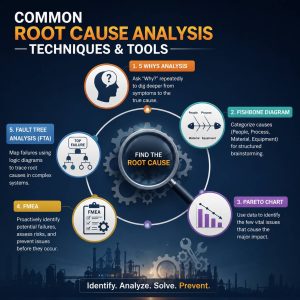
There are different tools and techniques to identify the root cause depending on the problem severity, system parameters, and available strategies.
- ‘5 Whys’ Analysis: It broadly addresses five questions starting with “why,” like “Why did it happen?” and “Why is that factor considered important in this problem?” from surface symptoms to the deep core issue. Best for simple and linear problems.
- Fishbone Diagram (Ishikawa): All the defined causes are distributed into multiple categories like people, materials, processes, and equipment for the stakeholders to have a clear picture of the problem. Best for visual brainstorming in a team.
- Pareto Chart: It uses a bar graph to display the frequency or impact of the problem on a chart. By utilizing this approach, engineers can easily shortlist the vital key issues that led to that harm.
- Failure Mode and Effects Analysis (FMEA): Failure Mode and Effects Analysis, as the name suggests, is the advanced form and widely implemented method where a prototype of the system is designed on a specific software, and its behavior is simulated under real-world conditions. This technique is helpful for risk prevention before the problem takes place.
- Fault Tree Analysis (FTA): It builds a logic diagram using Boolean symbols to trace a top failure down to root conditions. Best for complex engineering or safety systems.
Conclusion
RCA is not a one-size-fits-all solution. It is a key component of a broader umbrella of failure analysis, which includes both structured investigations and continuous historical data analysis to identify recurring bad actors, failure patterns, and cost drivers.
The whole idea behind the technique is to use all the relevant data, evidence, and systematic analysis methods to uncover causal factors. Additionally, tools like 5 Whys, Fishbone, Pareto, FMEA, and FTA serve as an innovation benchmark to support effective root cause identification.
If you are seeking trusted reliability engineering services, contact Dansob. We have a team of vastly experienced engineers who not only facilitate effective service delivery but also ensure you don’t have to encounter the same challenge repeatedly. We are committed to our clients’ success and thus are proud of our engineering excellence!
FAQs
- What are the 5 core principles of RCA?
RCA relies on identifying causal relationships, distinguishing symptoms from root causes, and validating findings with evidence. It also emphasizes systemic thinking, corrective action planning, and prevention of recurrence.
- What are Other Examples of Root Cause Analysis?
Common applications include equipment failure investigations, quality defect analysis, and supply chain disruption reviews. It is also widely used in safety incident reporting and process inefficiency audits across engineering operations.
- Which Method is Best for Root Cause Analysis?
The ideal method depends on the complexity of the issue and available data. For structured environments, Fault Tree Analysis and the 5 Whys are widely preferred for their clarity and traceability by reliability engineering solutions.
- Is RCA Part of Six Sigma?
Yes, RCA is a core component of the Six Sigma DMAIC framework, specifically within the Analyze phase. It supports data-driven identification of defects before implementing corrective measures.
- What Tool is Commonly Used for RCA?
Fishbone (Ishikawa) diagrams and fault tree analysis are among the most widely used RCA tools in engineering. Pareto charts are also frequently applied to prioritize causes by impact.