Maintainability engineering has moved from a back-office function to a boardroom priority. The key reason behind is the cost of unplanned downtime now touches every line of the P&L. B2B leaders in manufacturing, energy, transportation, and industrial services are actively aiming to integrate Artificial Intelligence (AI) into their routine operations.
The logic clearly reflects: shifting from reactive maintenance to AI-driven predictive asset management drastically lowers operational expenditure, extends equipment lifespan, and prevents catastrophic failures before they happen.
This blog examines the limitations of reactive repair, explains how AI-driven predictive maintenance reshapes engineering practice, and quantifies the business impact of adoption in terms of cost, uptime, and risk.
Key Takeaways
- Reactive repair strategies expose organizations to unplanned downtime, safety risks, and inflated lifecycle costs that compound over time.
- AI-driven predictive maintenance replaces guesswork with real-time sensor data, anomaly detection, and machine learning models that forecast failure before it occurs.
- Organizations adopting AI-based maintenance have reported significant downtime reductions and maintenance cost savings.
- Reliability and engineering maintenance practices are now inseparable from data infrastructure, IoT sensors, and continuous model refinement.
- Partnering with an experienced engineering services provider accelerates AI adoption while reducing implementation risk.
The Limits of Reactive Repair in Modern Reliability and Maintenance
Reactive repair, often described as “run-to-failure,” remains common across industrial sectors despite its well-documented drawbacks. Under this model, maintenance teams intervene only after a component has already failed, which means every repair is inherently a crisis response rather than a planned activity.
This approach requires no upfront investment in monitoring technology. Still, it consistently proves to be the most expensive strategy over an asset’s lifecycle, since failures often cause collateral damage to adjacent components and trigger unplanned production stoppages.
The operational consequences extend well beyond the cost of a single replacement part. Key limitations include:
- Unplanned Downtime: Failures halt production without warning, disrupting supply chains and delivery commitments.
- Shortened Asset Lifespan: Equipment is pushed to complete failure rather than serviced at optimal intervals, accelerating wear.
- Safety Exposure: Sudden mechanical breakdowns pose direct risks to personnel working near the equipment.
- Inventory Unpredictability: Spare parts must be sourced urgently, often at a premium, disrupting procurement planning.
Preventive maintenance came into use as an answer, fixing assets according to set calendar times. This way often changes parts that still work well. It also misses problems that happen between scheduled intervals. This shows the limits of both methods and schedule-based approaches.
Also Read: Reliability, Availability & Maintenance (RAM) Guide
How AI-Driven Predictive Maintenance Transforms Maintainability Engineering
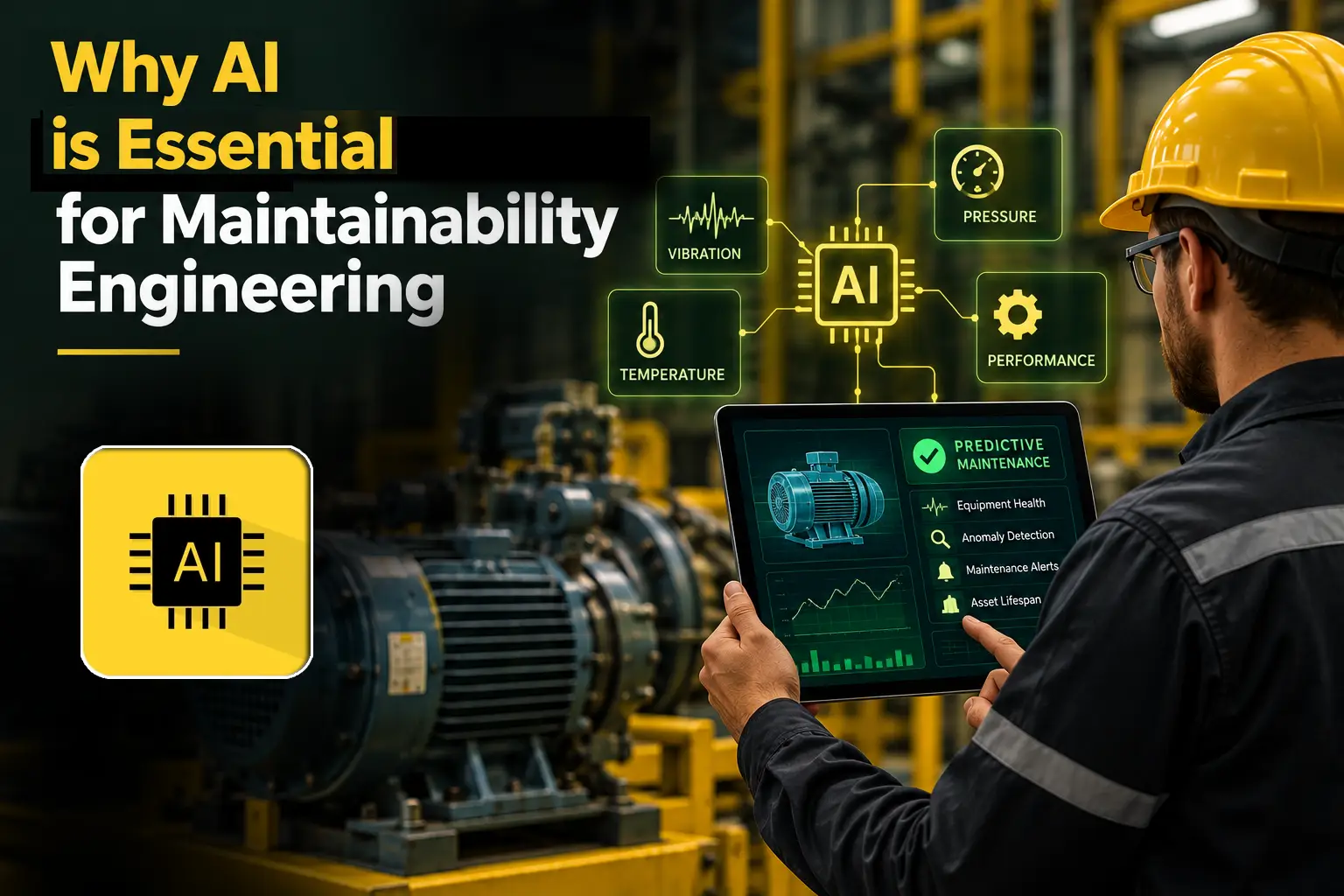
AI introduces a data-driven alternative that fundamentally redefines maintainability engineering. Rather than relying on averages, fixed schedules, or emergency response, AI-based predictive maintenance uses continuous sensor data to establish a machine’s normal operating signature and flag deviations long before they escalate into failures.
This transition moves maintenance from a calendar-based task to a precise, evidence-backed discipline grounded in real-time asset behavior.
The underlying architecture typically involves several coordinated components:
- IoT Sensors: Capture vibration, temperature, acoustic, and pressure data around the clock.
- Machine Learning Models: Distinguishes normal operating variance from early-stage anomalies.
- Edge Computing: Processes critical readings in milliseconds for instant alerts.
- Prescriptive Diagnostics: Flags faults and recommends specific corrective actions.
This change shows how reliability and maintainability engineering makes things dependable and easy to fix, coming together with data. Engineers do not wait until something goes wrong anymore; they take action when they see signs that something might be starting to wear out, like if a bearing is getting worse, a shaft is not lined up right, or if there is too much heat in electrical parts.
Business Impact of AI in Maintainability Engineering
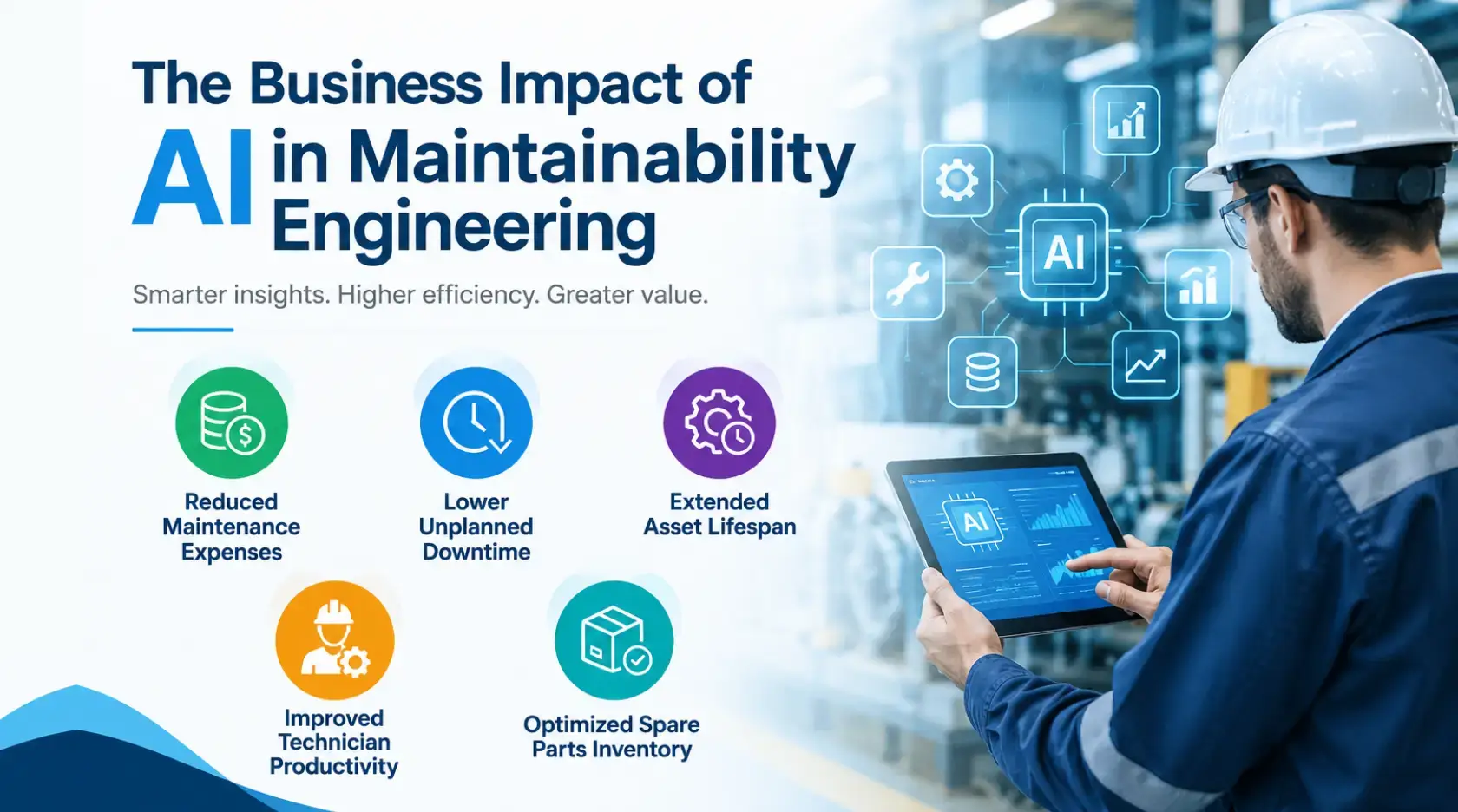
The financial and operational case for AI-driven maintenance is substantiated across multiple industry studies. Organizations transitioning from reactive or preventive strategies to predictive, AI-powered models consistently report measurable gains in cost control, equipment availability, and workforce safety.
These outcomes are not incremental; they represent a structural improvement in how capital-intensive assets are managed across their operational lifecycle. Documented business outcomes include:
- Reduced Maintenance Expenses: Enterprises have achieved significant cost reductions by servicing equipment based on actual condition rather than fixed schedules.
- Lower Unplanned Downtime: Predictive models have been shown to cut unplanned downtime drastically depending on sector and asset complexity.
- Extended Asset Lifespan: Continuous monitoring in energy and utilities has extended critical infrastructure lifespan significantly.
- Improved Technician Productivity: AI-driven visibility has substantially enhanced technician productivity in transportation and logistics operations.
- Optimized Spare Parts Inventory: Demand forecasting reduces both overstocking and emergency procurement costs.
Beyond the balance sheet, adopting AI makes companies stronger when it comes to managing risks. Detecting problems early helps avoid machine breakdowns that could hurt people. Keeping systems running without interruptions also protects service agreements. Keeps customers trusting the business. For business-to-business leaders, these results mean a more solid reason to keep investing in AI.
Conclusion
Reactive repair can no longer keep pace with the operational and financial demands of modern industry. To mitigate this vulnerability, AI has become the defining capability that separates resilient organizations from those absorbing avoidable downtime and cost.
By embedding predictive intelligence into everyday operations, maintenance engineering evolves from a cost center into a strategic advantage that protects uptime, safety, and long-term asset value. Organizations that delay this transition risk falling behind competitors who have already industrialized their reliability programs.
For organizations ready to make this shift, Dansob offers dedicated maintainability engineering services designed to integrate AI-driven predictive capabilities into existing operations with minimal disruption. Connect with Dansob today to explore how a tailored maintainability engineering program can support your operational goals.
Also Read: Reliability Engineering in Safety-Critical Systems Explained
FAQs
-
What is the Difference Between Predictive and Preventive Maintenance?
Preventive maintenance follows fixed calendar schedules regardless of actual wear. Predictive maintenance uses real-time sensor data and AI models to service equipment only when condition data indicates a genuine need.
-
How Quickly Can AI-Driven Maintenance Deliver Measurable Results?
Most organizations see initial insights within a few-month pilot phase, once sensors are deployed and baseline data is established. Full-scale cost and uptime benefits typically compound over the following twelve to eighteen months.
-
Does Implementing AI in Maintenance Require Replacing Existing Equipment?
No, most AI-driven solutions integrate with existing machinery through retrofitted IoT sensors and software platforms. This makes adoption feasible without large-scale equipment replacement.
-
What Data is Needed to Start an AI-Based Predictive Maintenance Program?
Organizations need historical maintenance records, real-time sensor data such as vibration and temperature, and consolidated asset information. Consistent, high-quality data is essential for reliable model performance.
-
How Does AI Adoption Affect Workforce Roles in Maintenance Teams?
AI does not replace maintenance technicians; it shifts their role toward interpreting data-driven insights and executing precise, prioritized repairs. Teams become more strategic, focusing on prevention rather than constant firefighting.