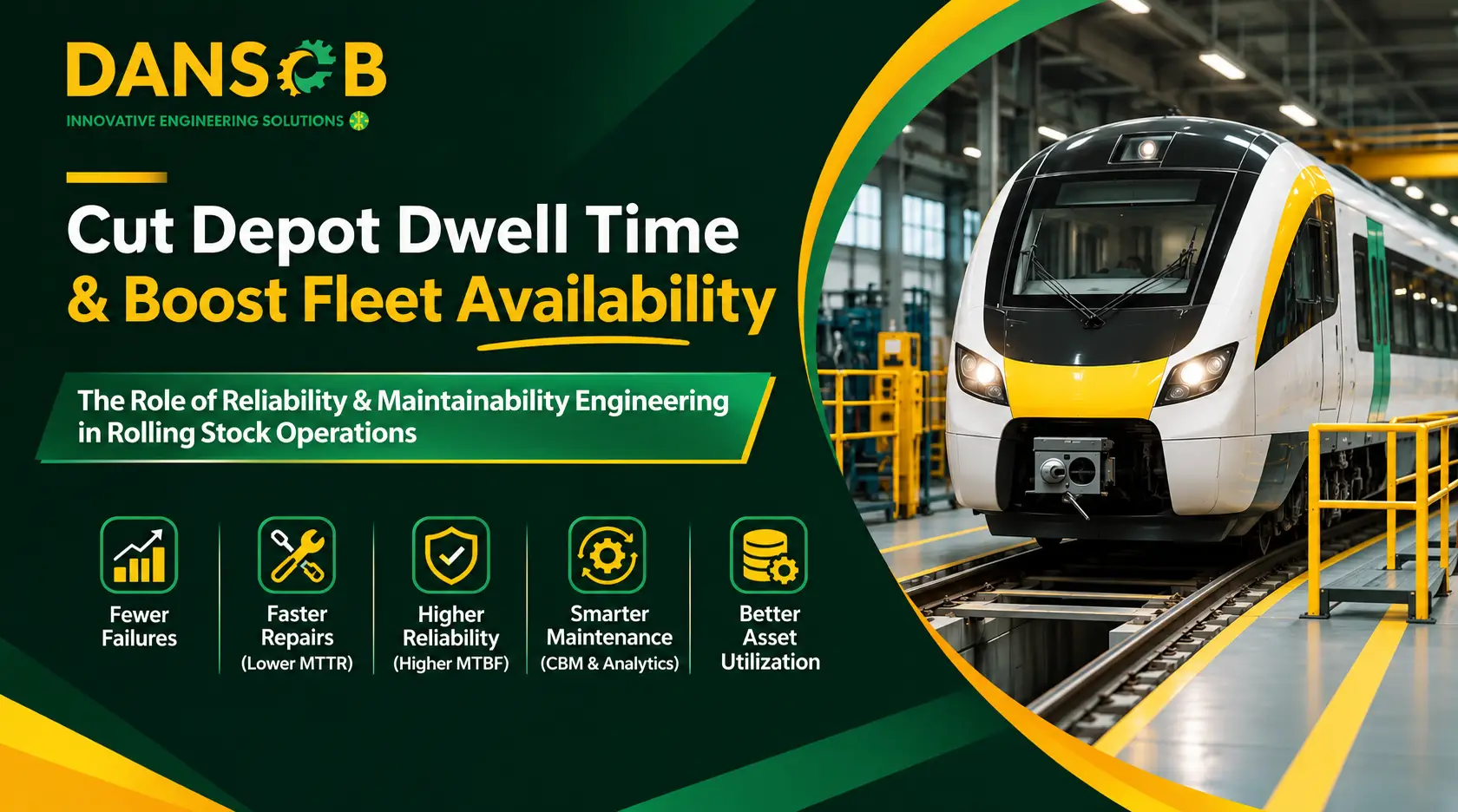
Depot dwell time directly degrades operational availability and revenue potential. While repair queues remain congested, prolonged maintenance cycles rarely stem from shop-floor productivity bottlenecks. Rather, they originate from systemic issues, recurring equipment failures, protracted diagnostic workflows, and suboptimal maintainability. Reliability and maintainability engineering is specifically designed to solve this challenge!
This blog is designed for rail operators, fleet owners, and maintenance leaders looking to explore how maintainability and system reliability engineering target the root causes of extended depot stays to keep assets in revenue service longer.
Key Takeaways1. Recurrent Failure Erodes Fleet Availability: Re-entry into maintenance for identical faults incurs cumulative bay downtime and labor costs that cannot be recovered. 2. Diagnostic & Supply Chain Lag Exceeds Wrench Time: Extended dwell times stem primarily from fault isolation delays, missing spares, and bay congestion, rather than the repair execution itself. 3. Maintainability Drives Lifecycle Velocity: Component accessibility, testability, and modular replacement parameters dictate Mean Time To Repair (MTTR) across the asset’s lifespan. 4. Data-Driven Reliability Prevents Unplanned Outages: Historical failure mode analytics enable precise inspection, strategic inventory allocation, and preemptive component replacements. 5. Cross-Functional Alignment Maximizes Operational Throughput: Reliability enhancements shorten depot stays in scenarios where maintenance schedules dynamically align with bay availability, crew allocation, and spare parts inventory. |
Why Do Rolling Stock Units Spend Too Long in the Depot?
Rolling stock dwell time directly impacts fleet availability and operational revenue. Prolonged maintenance cycles stem from a compound breakdown of diagnostic efficiency, parts availability, and facility throughput, increasing total turnaround time from arrival to release.
Six root causes consistently drive depot delays:
- Recurrent Failures: Repeat faults force redundant maintenance visits, consuming critical bay capacity and inflating labor expenditures for unrecovered issues.
- Protracted Diagnostic Workflows: Inadequate onboard diagnostic logging forces technicians to manually isolate root causes, consuming hours before physical repair begins.
- Sub-Optimal Maintainability & Component Access: Inaccessible hardware architecture requires extensive disassembly simply to inspect or swap basic components, inflating Mean Time to Repair (MTTR).
- Supply Chain Disruption & Spares Bottlenecks: Stockouts and extended supplier lead times leave assets stranded in bays.
- Depot Infrastructure & Layout Constraints: Spatial limitations, rigid track access, and unmanaged arrival peaks create chronic queuing across work bays and staging tracks.
- Calendar-Based vs. Condition-Based Maintenance: Lacking reliability and maintainability engineering, rigid calendar servicing introduces unnecessary tasks while overlooking early degradation signals.
Because bay utilization is interdependent, a single extended maintenance visit creates downstream schedule slippage across the entire fleet. Crucially, each failure metric is quantifiable, allowing maintenance leadership to prioritize high-impact interventions.
Also Read: Why Rail Vehicle Design Gaps Increase Project Costs and How Rolling Stock Solutions Can Help
How Reliability and Maintainability Engineering Reduces Unplanned Repairs and Repeat Failures
Reliability maintenance engineering targets systemic asset downtime by isolating failure root causes, eliminating design vulnerabilities, and streamlining repair execution. While reliability engineering reduces failure frequency (MTBF), maintainability engineering minimizes repair duration (MTTR). This dual approach equips metro, regional, and freight operators to permanently address chronic defects across high-wear subsystems, including braking, door systems, traction drives, and bogies.
Five core engineering initiatives yield the highest impact on operational availability:
- Root Cause Failure Analysis (RCFA): System reliability engineering analyzes component degradation mechanisms and failure propagation, enabling engineering teams to eliminate underlying design flaws rather than repeatedly replacing failed parts.
- Design for Maintainability (DfM): Maintainability engineering optimizes physical component access, diagnostic accessibility, and modular replacement procedures, drastically reducing wrench-time requirements.
- Predictive Failure Analytics: Historical fault logging and telemetry analysis identify premature wear patterns, allowing maintenance teams to intervene before line-of-route failures occur.
- Condition-Based Monitoring (CBM): Real-time sensor data and health indicators transition operations from fixed calendar servicing to dynamic, condition-driven maintenance intervals.
- Integrated Logistics & Bay Simulation: Predictive failure modeling informs spare parts staging and bay capacity management. Advanced scheduling and simulation tools allow depots to validate operational changes virtually before live rollout.
The table below outlines how each strategic action directly reduces depot dwell time.
|
Engineering action |
Problem it removes |
Effect on dwell time |
|
Root cause analysis |
Same fault returning after repair |
Fewer repeat visits |
|
Easier access design |
Long dismantling before inspection |
Shorter repair per visit |
|
Failure data tracking |
Surprise breakdowns |
Fewer unplanned depot entries |
|
Condition-based inspection |
Unneeded or missed tasks |
Better targeted visits |
|
Spares and bay planning |
Waiting for parts or bays |
Faster release to service |
Fleet operators achieve maximum impact when these initiatives are executed synchronously, compounding gains across component reliability, maintainability design, and predictive scheduling to eliminate redundant dwell time.
Conclusion: Make Shorter Depot Dwell Time an Engineering Priority with Dansob
Prolonged dwell time is rarely a workforce issue; it is an engineering and planning challenge driven by recurring faults, slow triage, inventory shortages, and bay constraints. Reliability and maintainability engineering resolves each bottleneck by driving down both failure frequency and repair duration, freeing up technicians, infrastructure, and revenue-earning assets.
Accelerate fleet availability with Dansob. Our expert team converts complex failure telemetry and depot operational logs into actionable engineering decisions that eliminate repeat work orders and accelerate service release.
Looking to know more? Click on this LINK to book a free consultation!
Also Read: Beyond Reactive Repair: Why AI is Essential for Maintainability Engineering
FAQs on Rolling Stock Reliability and Maintainability Engineering
1. What is a Good Depot Dwell Time Target for a Rail Fleet?
Dwell time benchmarks depend on train specifications, maintenance severity (light servicing vs. heavy overhaul), and depot throughput constraints. Rather than relying on arbitrary industry averages, fleet leaders should measure target vs. actual turnaround times across each servicing category to pinpoint and resolve operational delays.
2. What is the Difference Between MTBF and MTTR?
MTBF (Mean Time Between Failures) is the average running time between two failures, which shows how reliable a part or system is. In contrast, MTTR (Mean Time to Repair) is the average time needed to restore a failed item, which shows how easy it is to maintain. A higher MTBF and a lower MTTR together mean fewer and shorter depot visits.
3. How Do Preventive and Corrective Maintenance Differ for Rolling Stock?
Preventive maintenance is planned work that aims to prevent failure beforehand. Corrective maintenance is repair work that follows a fault or breakdown. A healthy fleet plan keeps the second type as minimal as possible.
4. What Does RAMS Mean in the Rail Industry?
RAMS stands for Reliability, Availability, Maintainability, and Safety. In rail systems engineering, RAMS defines key performance indicators (KPIs) and verification frameworks that govern whole-life asset performance, ranging from initial design through decommissioning.
5. Can Older Trains Benefit From This Approach?
Yes. Legacy fleets often yield the highest return on investment because extensive historical failure data precisely pinpoints root causes of recurring downtime. Operators can optimize inspection protocols, inventory staging, and maintenance workflows immediately without capital-intensive vehicle redesigns, targeting engineering modifications strictly on high-impact bottlenecks.