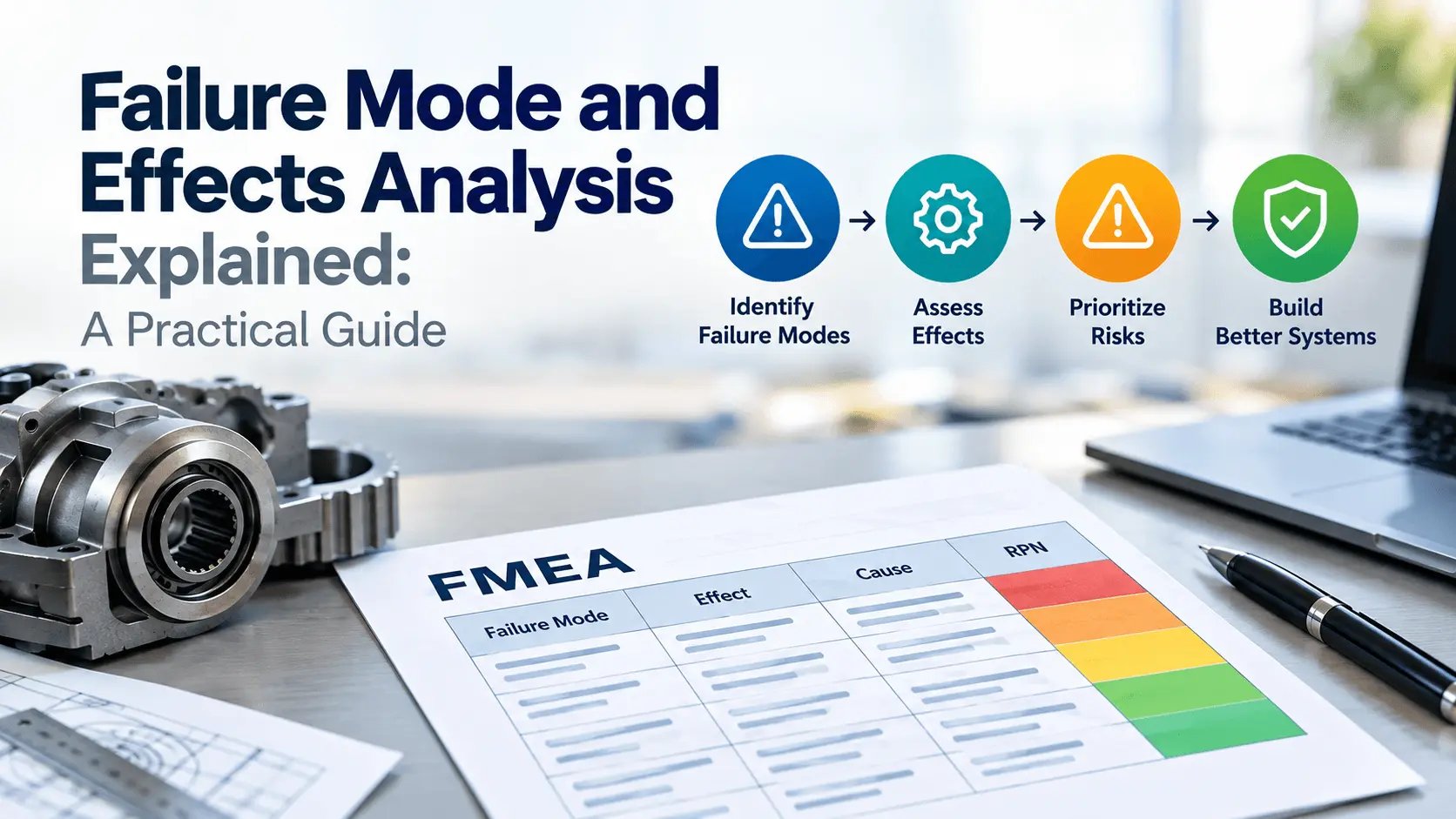
The Failure Mode and Effects Analysis process allows companies to recognize design and performance threats ahead of time. This way, engineers will be able to create effective products and systems that will operate efficiently in practical use.
What is Failure Mode and Effects Analysis?
Failure Mode and Effects Analysis is a systematic approach used in reliability engineering to study how systems, components, or processes might fail. It focuses on three key questions:
- What can go wrong?
- Why could it happen?
- What would be the impact?
In doing so, companies can adopt a prevention approach rather than a reactive one when problems arise.
The Importance of FMEA in Reliability Engineering
Reliability engineering is concerned with the reliability of systems over their lifecycle. FMEA is relevant to this field because it acts as a preventative measure for risk assessment and management.
Some key benefits are:
- Finding design and process weaknesses early.
- Reducing downtime and unexpected failures.
- Ensuring that the products and systems are safe and compliant with standards.
- Reducing costs in the operations in the long run.
- Better decision-making through risk assessment.
FMEA is commonly used in industries like manufacturing, aviation, automobiles, healthcare, and others to ensure that performance standards are met.
Key Components of FMEA
Failure mode and effect analysis (FMEA) is a risk assessment technique that is fundamentally built on several quantifiable elements:
- Severity (S)
- Measures how serious the results of a failure can be
- Value scale from 1 to 10, where 10 represents extremely severe consequences
- Occurrence (O)
- stands for the chance of a failure taking place
- The scale of values is from 1 to 10, implying from hardly to very often
- Detection (D)
- Indicates the extent to which a failure can be identified prior to its occurrence
- The scale of values is from 1 to 10, at which 10 implies that the failure detection is very hard
These three factors are the basis of FMEA risk assessment.
Understanding Risk Priority Number (RPN)
Teams calculate the Risk Priority Number to prioritize actions:
- RPN = Severity × Occurrence × Detection
For example:
- Severity = 8
- Occurrence = 7
- Detection = 6
- RPN = 336
The higher the RPN, the greater the risk is and that situation has to be dealt with first.
FMEA Step-by-Step Approach
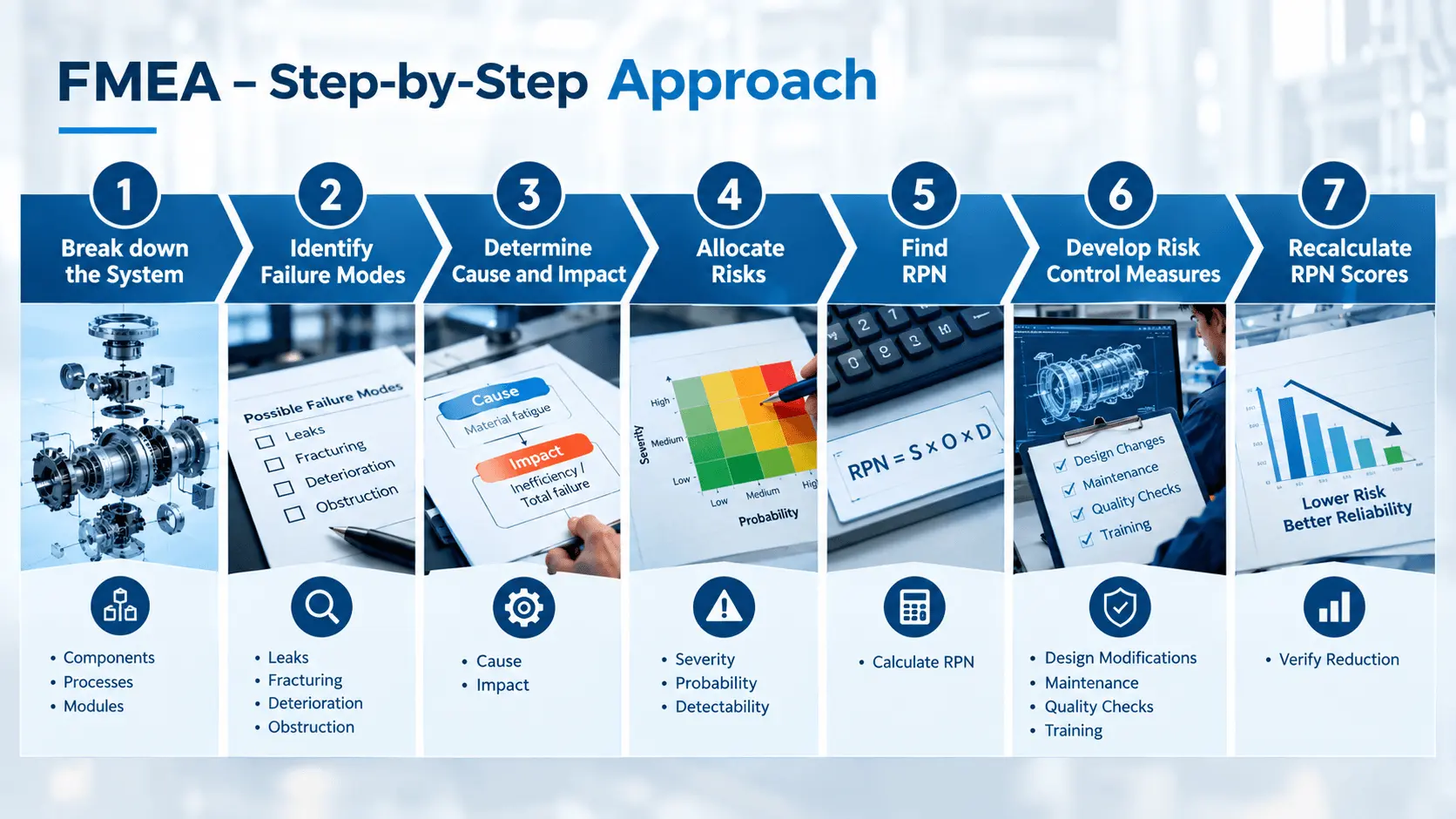
Conducting FMEA includes a series of steps. Each step makes things clearer and easier to decide.
- Break down the System
The first step is to disassemble the system into very small parts or processes.
- Some examples include brake systems, processes of assembling, or a computer software module.
- Identification of Failure Modes
Enumerate all the possible modes in which failures occur for each piece or process.
- Leaks
- Fracturing
- Deterioration
- Obstruction
- Determine the Cause and Impact
Determine the reason for failure and the possible impacts of such an occurrence.
- Cause: Fatigue of the material
- Impact: It could result in inefficiency or total failure of the system.
- Allocate Risks
Assess risk on a scale for severity, probability of occurrence, and detectability.
- Find RPN
Calculate the product of all three scales to prioritize risks.
- Develop Risk Control Measures
Take appropriate steps to mitigate identified risks.
- Modifications in design
- Maintenance
- Establishing Quality Checks
- Training to the team
- Recalculate RPN Scores
Check whether the risk levels have been reduced.
Sample FMEA Table
Here’s a basic example for a brake system, adapted for clarity:
|
Item |
Failure Mode |
Cause |
Effect |
Severity |
Occurrence |
Detection |
RPN |
Action |
|
Brake O-ring |
Internal leak |
Wear or damage |
No wheel braking |
10 |
4 |
3 |
120 |
Add redundancy |
|
Brake Hose |
Pressure drop |
Crack from age |
Slow deceleration |
8 |
3 |
5 |
120 |
Inspect regularly |
Types of FMEA
The application of FMEA may be done at different stages of the life cycle of products/systems/processes.
- Design FMEA (DFMEA): Deals with the product designs.
- Process FMEA (PFMEA): Deals with the manufacturing process or operation process.
- System FMEA: Analyses the interaction within the system.
Each has its own importance and application, but uses the same method.
Role of FMEA in Business Operations
FMEA enables large organizations to gather the necessary information and make more informed strategic decisions. On top of that, it covers the major goals of enhancing efficiency, safety, and compliance with standards.
FMEA pairs slightly with maintainability engineering that focuses on making a system easier to repair and stay operational with time. Such a strategy enhances the overall lifespan performance of the system and system cost reduction.
How Dansob Supports Reliability Excellence
Dansob aids in formulating reliability frameworks that include FMEA. Risk assessment performed in Dansob will reflect the activities that are really going on within the organization.
Dansob integrates engineering expertise and techniques to enable early identification of potential risks in products and system designs.
Conclusion
Failure Mode and Effects Analysis is still one of the most useful tools in reliability engineering. It helps teams move from reacting to problems to managing risks before they happen.
Large organizations cannot afford to skip this approach. It is key to creating systems that are safe, efficient, and reliable, especially in tough conditions.
FAQs
- What is the main purpose of Failure Mode and Effects Analysis?
It helps identify potential failures in systems or processes and prioritizes actions to prevent them before they occur.
- How is risk measured in FMEA?
Risk is measured by looking at three things: severity, occurrence, and detection. These are multiplied together to get the Risk Priority Number.
- When should organizations perform FMEA?
Teams should do FMEA when designing, before starting a new process, and any time systems are updated or changed.
- What industries FMEA is most often used in?
Manufacturing, aerospace, automobile and healthcare sectors are the main users of FMEA to enhance the safety, quality and reliability of their products and processes.
- In what ways does FMEA contribute to business performance?
FMEA identifies risks, thereby reducing failures, cutting down maintenance costs, boosting system availability and helps management in taking efficiently informed decisions through systematic risk evaluation.