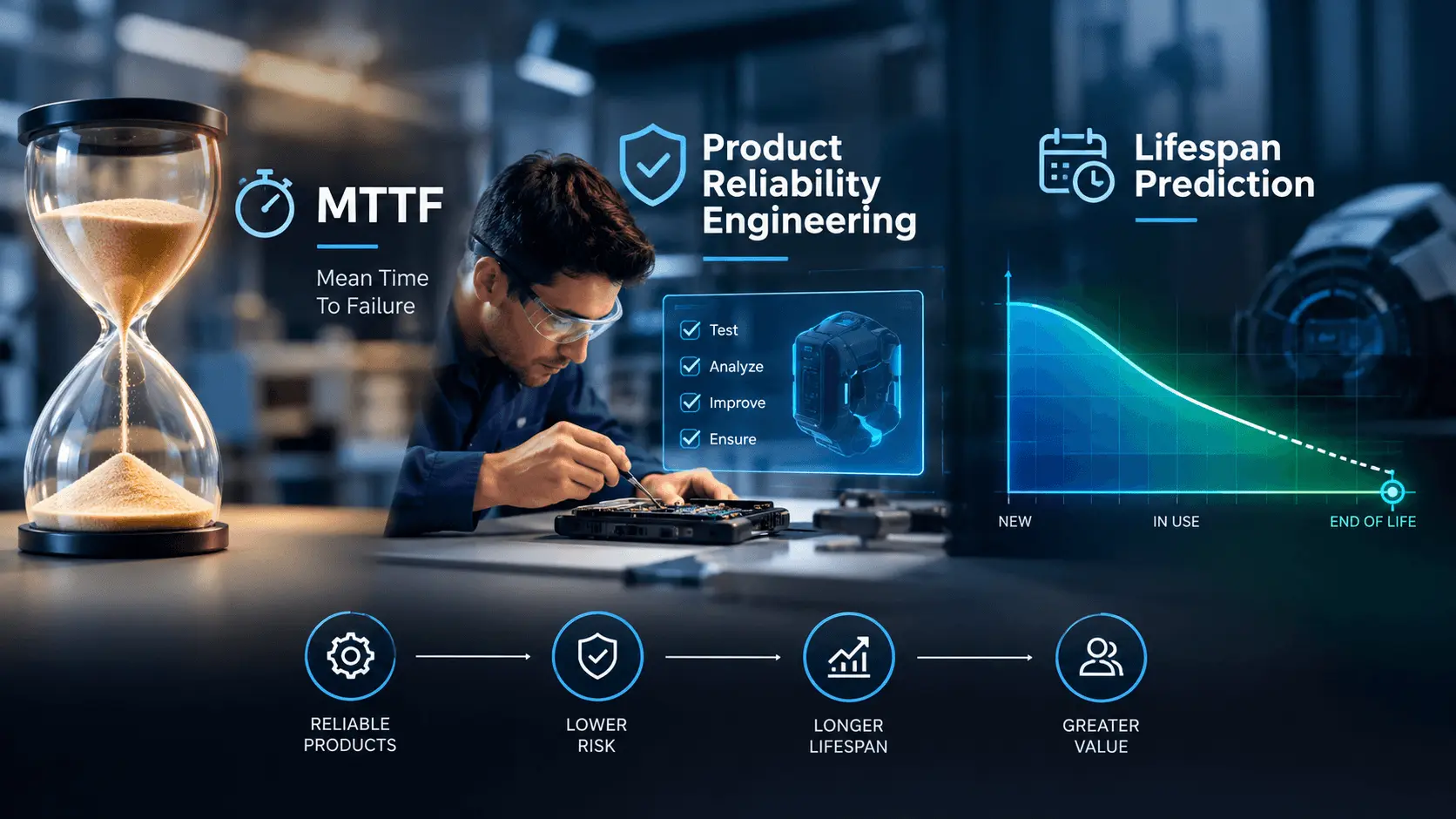
Today, product reliability engineering uses metrics like Mean Time to Failure (MTTF) to predict how long products will last, lower risks, and create more durable designs. By using data-driven insights, companies can develop products that work reliably in real-life situations.
What is Mean Time to Failure (MTTF)?
The Mean Time to Failure, or MTTF, is how long, on average, a product that cannot be repaired works before it stops. It is used by engineers to estimate how long a product will last and to improve the design of a product.
MTTF is used for products that cannot be repaired when they fail. This means:
- Lightbulbs
- Electronic chips
- Conveyor rollers
- Sealed batteries
When these parts fail, teams replace them rather than repair them.
Key Characteristics of MTTF
- It shows the average time a product works under normal conditions.
- The calculation is based on past data or test results.
- A higher MTTF means the product lasts longer.y.
- It helps guide design choices early on.
For companies, MTTF is more than just a number. It shows quality and how well a product performs over time.
Why MTTF Matters in Engineering Design
MTTF plays a key role in how engineers design and test systems. It also helps businesses match their performance goals with what actually happens in the real world.
Key Benefits of Using MTTF
- Improved product durability
Engineers design parts that will last longer when used.
- Better warranty planning
Companies will be able to tell when failures will occur, thus minimizing risks.
- Optimized replacement cycles
Businesses will be able to decide when a part that cannot be repaired should be replaced.
- Enhanced customer trust
Companies will improve their reputation by providing durable products, thus reducing customer complaints.
- Data-driven decisions
Teams will make decisions based on clear data, not guesses.
For big companies, these benefits lead to saving money and staying ahead of competitors.
MTTF vs Other Reliability Metrics
MTTF is just one part of a bigger reliability framework. Knowing the related metrics helps organizations pick the best strategy.
Key Comparisons
1. MTTF (Mean Time to Failure)
- This applies to systems that cannot be repaired.
- It focuses on the time until the first failure happens.
- It is used to predict how long something will last.
2. MTBF (Mean Time Between Failures)
- This applies to systems that can be repaired.
- It measures the time between failures.
- Helps plan maintenance schedules.
3. MTTR (Mean Time to Repair)
- This applies to all types of systems.
- It measures how quickly repairs are done.
- Indicates downtime impact.
Summary Table
- MTTF → Replace after failure
- MTBF → Repair and continue use
- MTTR → Restore system quickly
The engineering teams will select their appropriate lifecycle strategy because of this distinction.
How to Calculate MTTF
The value of MTTF can be calculated using a simple formula, but it is based on the accuracy of the data provided and the sample size.
Basic Formula
MTTF = Total operational hours of all units / Total units
Example
- Assume we have 40 units of identical parts, all of which operate for a total of 10,000 hours.
- MTTF = 10,000 / 40
- MTTF = 250 hours
The above means that we expect each of these parts to last for an average of 250 hours.
Keep these points in mind while calculating MTTF
- Use large samples to increase the accuracy of the calculation.
- Use real-world data collected during operation, rather than estimates.
- Keep the calculation up to date as more data is collected.
- Validate the calculation by testing and simulation.
Advanced System Lifespan Prediction Methods
Basic MTTF calculations provide a starting point for fault analysis. Advanced methods enable a better understanding of failure scenarios that cause system breakdowns.
1. Accelerated Life Testing (ALT)
- This test simulates extreme conditions.
- It helps predict long-term performance in a shorter time.
- It also identifies weak points in the design early on.
2. Weibull Distribution Modeling
- This method identifies different failure patterns.
- It also addresses early failures and the wear-out phase.
- It can be used even if the data are limited.
3. Physics-Based Modeling
- The method uses material properties together with stress factors to determine outcome results.
- The system predicts failure occurrences together with their respective failure modes.
- The system enables design process improvements through its development capabilities.
Industrial Applications of MTTF
MTTF plays a critical role across industries where performance and safety are essential.
- Manufacturing
Optimize when to replace components and cut downtime.
- Aerospace
Create backup systems and handle risks better.
- Electronics
Make chips more reliable and better at handling heat.
- Energy and Utilities
Keep critical infrastructure running without interruptions.
Real-World Impact
- Predictive models, when combined with MTTF, can achieve high accuracy depending on data quality and methods.
- The reduction of failure rates leads to a decrease in operational expenses.
- The improved reliability of products leads to higher levels of customer satisfaction.
Companies can use MTTF to stop their current practice of solving problems through reactive methods and start creating advanced planning systems.
Limitations of MTTF
MTTF is useful, but it has some limitations that engineers need to consider.
Key Challenges
- It assumes failure rates stay constant.
- It doesn’t show how things wear down over time.
- It can’t tell you exactly when something will fail.
- May oversimplify complex systems.
How to Overcome These Limitations
- Use MTTF together with Weibull analysis.
- Apply Failure Modes and Effects Analysis (FMEA).
- Perform regular inspections and monitoring.
- Include real-time performance data in your analysis.
Role of Engineering Analysis in Improving MTTF
Engineering in today’s world requires more than just fundamental computations; organizations need to implement complex reliability engineering solutions.

Key Engineering Approaches
- Design for Reliability (DFR)
Engineers create systems that are designed for failure prevention.
- Validation Testing (EVT, DVT, PVT)
Engineers perform tests on their product at different stages of development.
- Simulation and Modeling
Digital models are employed for the prediction of product performance under different conditions.
- Data-Driven Optimization
Feedback is used for the optimization of accuracy.
Connecting MTTF to Reliability Engineering
MTTF is used as a foundation for product reliability engineering. It offers measurable insights.
How MTTF Integrates in Reliability Engineering
- Sets reliability goals during the design phase
- Assists in selecting appropriate materials and parts
- Aids in identifying and minimizing risks
- Ensures alignment of engineering with business objectives
Organizations that factor in MTTF in their reliability strategy reap a huge reward. They reduce failures and improve their performance while adding long-term value.
Conclusion
MTTF is also vital in the prediction of the lifespan of the product, hence improving the performance of the systems involved. It assists engineers in the production of reliable and long-lasting products, hence lowering the failure rate of the systems involved.
For organizations that want to achieve maximum reliability and innovative solutions, Dansob offers advanced engineering support, which serves as their highest solution. The systems we create together will provide you with increased durability, operational reliability, and enhanced business performance.
FAQs
- What does MTTF mean?
MTTF, which stands for Mean Time to Failure, is the average time a product that cannot be repaired continues to work before it completely stops.
- How does MTTF differ from MTBF?
MTTF is used for products that cannot be repaired, whereas MTBF measures the time between failures for products that can be repaired.
- Why is MTTF important for businesses?
MTTF is important for businesses because it can be used to estimate product life, reduce failures, increase product reliability, and cut costs.
- How can businesses increase MTTF?
MTTF can be increased in a business by using high-quality materials, testing products, and applying engineering analysis.
- Is MTTF on its own sufficient for analysis?
No, MTTF should be used in combination with other methods, e.g., Weibull analysis and reliability engineering solutions, to improve analysis accuracy.