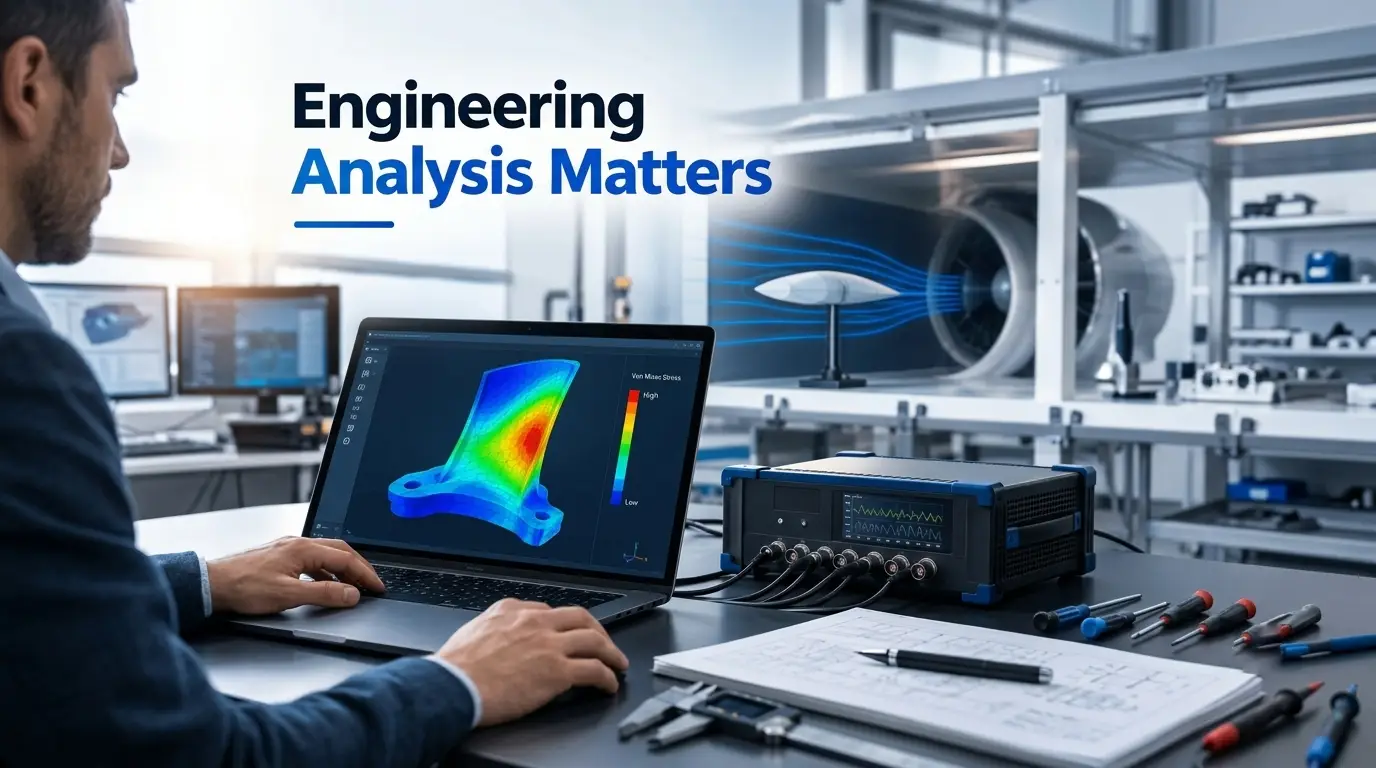
In the modern dynamic world, product design needs to be flawless. Even the slightest error in the design stage can prove fatal for users when the product is used in real-world conditions. That’s why engineering analysis services for product design have become a basic yet uncompromisable step for new-age businesses.
Data-driven product design has become the norm in 2026. Be it any sector, aerospace, automotive, medical, semiconductor, battery, or food sector, the performance of their products needs to be tested and verified before actual production starts. Engineering analysis helps in that.
At Dansob, we help organizations build high-performance products through structured analysis, reliability planning, maintainability evaluation, and safety validation. This guide explains the complete workflow modern businesses should follow.
Why Engineering Analysis Matters in 2026
Product complexity continues to increase. Electronics integrate with mechanics. Software interacts with hardware. Materials must meet environmental and regulatory demands.
Without structured analysis, companies face:
- Expensive design revisions
- Delayed certifications
- Field failures
- Warranty losses
- Brand damage
Engineering analysis reduces uncertainty early. It replaces guesswork with measurable insight. This approach protects budgets and timelines.
Product failure is unacceptable, regardless of any industry. That’s why aerospace, defense, rolling stock, petroleum, and pharmaceutical sectors emphasize a robust product design to identify risk before it becomes a hazard and affects the users or expected performance.
The Complete Workflow for Modern Product Design
A successful workflow follows a logical sequence. Each phase builds on the previous one. Skipping steps creates hidden risks.
-
Requirement Definition and Technical Planning
Every project begins with clarity.
Teams must define:
- Functional performance targets
- Environmental conditions
- Regulatory standards
- Lifecycle expectations
- Maintenance strategy
Clear requirements guide all future analysis. They prevent scope confusion and design drift.
At Dansob, we convert business goals into measurable engineering parameters. This alignment ensures technical efforts support commercial objectives.
-
Concept Level Engineering Evaluation
Concept validation prevents costly redesign later.
During this phase, engineers:
- Evaluate load paths
- Assess thermal behavior
- Review material compatibility
- Identify stress concentration zones
Early simulation helps teams compare multiple design alternatives. Weak concepts are eliminated before detailed development begins.
Industries such as battery manufacturing and automotive benefit greatly from early validation. It reduces prototype iterations and compresses development time.
-
Detailed Design and Simulation
Once a concept is selected, detailed modeling begins.
This phase includes:
- Structural analysis
- Thermal analysis
- Fatigue evaluation
- Vibration assessment
- Failure mode review
High-fidelity simulation ensures the product performs under real operating conditions.
For medical and semiconductor products, precision matters. Even minor deviations can impact functionality. Detailed analysis prevents performance surprises.
At Dansob, our engineering analysis services focus on practical outcomes. We provide actionable insights rather than theoretical reports.
Integrating Reliability into Product Development
Modern customers expect durability. Investors expect predictable performance. Regulators demand documented validation.
This is where system reliability engineering becomes critical.
Reliability is not an afterthought. It must be embedded in design.
Reliability Engineering Workflow
A structured reliability approach includes:
- Reliability allocation based on product targets
- Failure mode identification
- Quantitative risk assessment
- Life prediction modeling
- Reliability growth planning
System reliability engineering allows businesses to predict product lifespan before market release.
The more reliable a product or system is, the better it can be utilized, and it sometimes is the separating line between life and death. For instance, in the aerospace and defence industries, mission success is determined by reliable aircraft.
At Dansob, we integrate reliability planning into early design stages. This prevents expensive field corrections.
Maintainability Engineering for Lifecycle Efficiency
Performance alone does not guarantee success. Products must be easy to maintain.
Maintainability engineering answers key questions:
- How quickly can a component be replaced?
- What tools are required?
- Can access points reduce downtime?
- Is preventive maintenance feasible?
Some industries, like rolling stock, utilities, and petroleum, have to keep running the entire time. They cannot afford to stop.
When rolling stock, utilities, and petroleum are not working, it means they are losing money.
By evaluating maintainability early, companies reduce service costs and improve customer satisfaction.
Dansob works closely with product teams to optimize accessibility, service intervals, and repair strategies. This ensures the product performs throughout its lifecycle.
System Safety Engineering in Product Design
Safety is another aspect of product design that is non-negotiable. The products must be designed in a way that they do not pose any threat to the users and that’s where system safety engineering comes into play. System safety engineering is about finding problems before they hurt someone.
The process typically includes:
- Hazard identification
- Risk classification
- Mitigation strategy development
- Design verification
- Compliance documentation
Medical devices, defense equipment, and semiconductor tools require strict safety validation.
A structured safety workflow prevents recalls and regulatory penalties.
Dansob integrates safety evaluation alongside performance analysis. We do not treat safety as a separate activity. It is embedded within the design process.
Validation and Verification
Analysis must translate into proof.
Verification confirms that design outputs meet requirements. Validation confirms the product fulfills its intended purpose.
This phase may include:
- Physical testing correlation
- Simulation refinement
- Environmental stress screening
- Performance benchmarking
Engineering design and analysis services become most valuable when simulation aligns with test data. This alignment builds confidence across stakeholders.
At Dansob, we ensure analytical models reflect real-world behavior. This reduces certification delays and approval risks.
Industry Applications Across Sectors
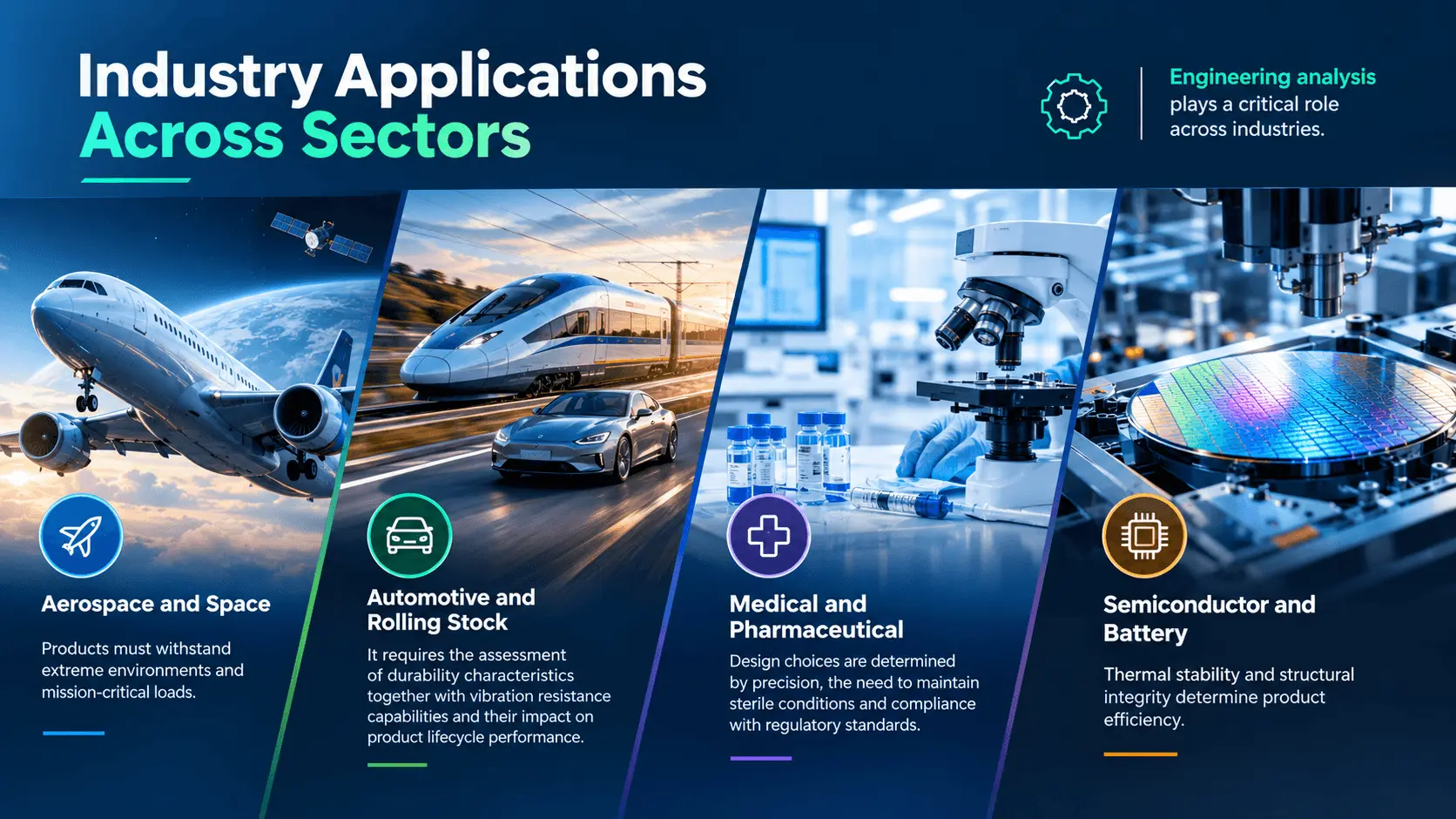
Engineering analysis plays a critical role across industries.
-
Aerospace and Space
Products must withstand extreme environments and mission-critical loads.
-
Automotive and Rolling Stock
It requires the assessment of durability characteristics together with vibration resistance capabilities and their impact on product lifecycle performance.
-
Medical and Pharmaceutical
Design choices are determined by precision, the need to maintain sterile conditions and compliance with regulatory standards.
-
Semiconductor and Battery
Thermal stability and structural integrity determine product efficiency.
-
Beverage and Food
Hygiene, material compatibility, and maintainability ensure operational continuity.
Across all sectors, system reliability engineering supports predictable product behavior under real operating conditions.
Why Businesses Choose Dansob
Modern businesses require more than isolated calculations. They need strategic engineering partners.
Dansob provides:
- End-to-end analysis workflow support
- Integrated reliability and maintainability planning
- Structured system safety engineering
- Clear and data-driven reporting
- Cross-industry expertise
We focus strictly on product performance improvement. Our teams work collaboratively with client engineering departments. We align technical insights with business timelines.
Our engineering analysis and design services help companies:
- Reduce development risk
- Accelerate time to market
- Improve product durability
- Strengthen regulatory compliance
- Lower lifecycle costs
We prioritize clarity in communication. Decision makers receive concise, structured findings. Engineers receive detailed technical validation.
This balanced approach makes Dansob a trusted partner across industries.
Conclusion
In 2026, the engineering analysis is what defines the strength of a company. When companies make sure to include reliability, maintainability, and safety from the start, they do much better than their competitors.
Businesses that invest in structured engineering analysis gain measurable returns. They reduce uncertainty while increasing product confidence.
Engineering analysis proves to be a foundational pillar for the modern product design process. Paired with skilled engineers and high-tech analysis, you can make products that work well, are safe, and perform as intended when people use them.
Dansob provides you with state-of-the-art engineering design and analysis services for a variety of sectors. Contact us today to explore our engineering design and analysis services.
FAQs
- What are engineering analysis services?
Engineering design and analysis services show you how your product will perform. This way, you can test the performance, reliability and safety of a product before its production starts.
- Why is reliability important in product design?
The product maintains steady performance throughout its life because reliability ensures it functions properly without failures or requiring warranty repairs.
- At which stage should reliability engineering be introduced?
The integration of reliability engineering should be done in the product development phase. It helps to develop products that require no future costly design changes.
- How does maintainability improve product performance?
Maintenance engineering decreases system downtime, makes repairs easier and it reduces operational costs throughout the entire lifespan of the product.
- How does Dansob support businesses across industries?
Dansob provides structured analysis, reliability, maintainability, and safety engineering tailored to complex product requirements.