Modern engineering systems have become increasingly complex and data-intensive. Consequently, hazards and associated risks are prevalent in such systems, and businesses often neglect them. The importance of system safety engineering becomes much more critical when we consider the catastrophic outcomes of these operations.
In this blog, we will gain an overview of system safety engineering and management, understand its core techniques, and learn how it addresses and mitigates associated risks. Finally, we will explore the real-world applications that make this domain irreplaceable.
Why Complex Systems Fail Without a Structured Safety Engineering Process
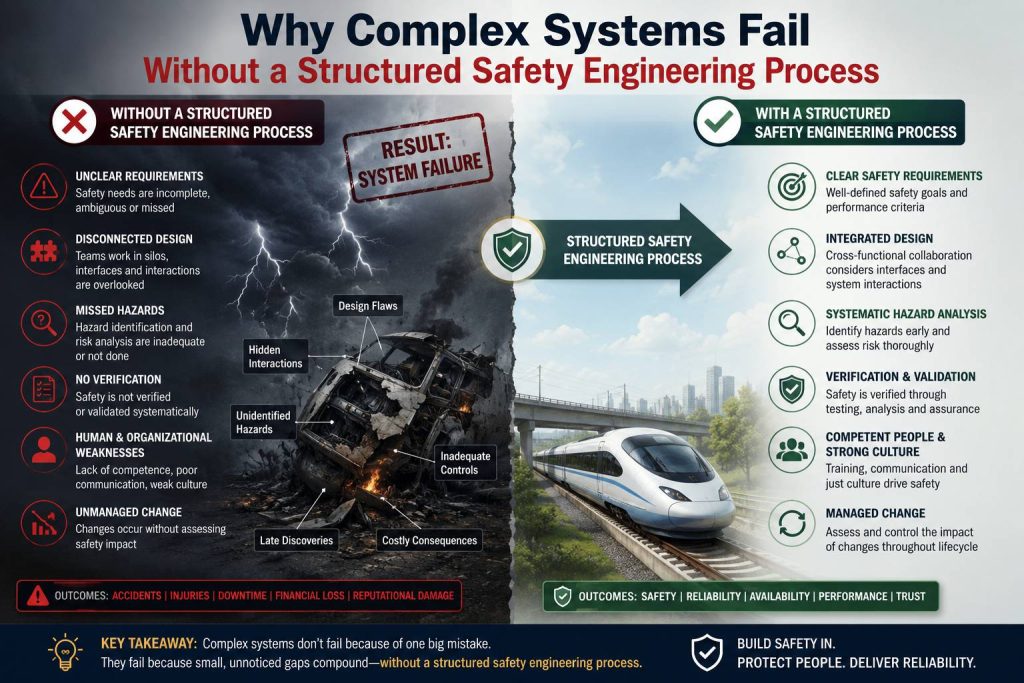
Complex systems often fail because hidden, unpredictable interactions and emergent behaviors cause minor anomalies to cascade into systemic catastrophes.
-
Emergent Properties
Emergent properties are system-wide collapses that don’t exist in any single component but manifest when components are combined into a system. Such properties are devastating and cause trigger resonance. For example, wind flutters in the Tacoma Narrows Bridge, where constant, steady wind hits a solid bridge deck.
-
Faulty Material Selection
Often, businesses choose the wrong raw materials to build a system, which then fails to withstand consistent, heavy loads when the yield point is reached. For example, businesses choose non-chemical-resistant materials to build pipelines in a chemical manufacturing plant rather than materials such as stainless steel.
-
Complexity of Fixes
When a system fails without a structured engineering framework, the post-accident remedies usually just add new layers of complexity or coupling, unknowingly creating new avenues for failure.
-
Hindsight Bias
After a disaster, teams often mistakenly look for an isolated “root cause” or blame human operators. This misunderstands the systemic nature of the failure.
-
System Tight Coupling
In a few instances, the joints are torqued beyond the required torque, which constrains their movement and can result in sudden breakage when the load exceeds the permissible threshold. This can occur in various couplings and universal joints in an automobile.
Core Techniques Used in System Safety Engineering to Identify and Control Hazards
System safety engineering and risk management employs proactive, structured analytical methods to identify potential hazards, assess associated risks, and apply targeted mitigations.
-
Fault Tree Analysis (FTA)
Fault Tree Analysis (FTA) is a top-down, deductive technique that begins with the undesirable event (accident) and continues backward to identify the specific component failure or operational failure that could cause it.
-
Failure Mode and Effects Analysis (FMEA)
Failure Mode and Effects Analysis (FMEA) is a bottom-up, inductive method that analyzes each component of the system separately, identifies the potential hazards, and combines them holistically to assess the potential threats.
-
Hazard and Operability Study (HAZOP)
A Hazard and Operability Study (HAZOP) is a hazard-prediction analysis that examines how deviations from the original design intentions or operating parameters might lead to hazardous conditions.
-
Preliminary Hazard Analysis (PHA)
This analysis is performed in the early stage of the design phase, establishing the system’s foundational hazards and determining hazard severity, hazard categories, and initial risk levels.
-
Systems-Theoretic Process Analysis (STPA)
Systems-Theoretic Process Analysis (STPA) analyzes how different components of the system interact, and poor control or communication among them can result in catastrophic consequences.
Real-World Applications of System Safety Engineering
These system safety engineering and management techniques can easily identify hazards in advance and help stakeholders to prevent associated system failure. With this versatility, they are widely leveraged across different industrial sectors.
-
Aerospace and Aviation
Engineers use frameworks such as SAE International ARP4754A to integrate safety requirements from the conceptual design phase.
-
Autonomous Automobile Systems
Self-driving cars require rigorous requirements for LiDAR systems and artificial intelligence (AI) to detect pedestrians and avoid collisions in unpredictable environments.
-
Medical Devices
Engineers apply IEC 62304 to medical device software development. This ensures that pacemakers, infusion pumps, and imaging scanners operate with highly predictable reliability, drastically reducing the risk of patient injury.
-
Rail and Mass Transit
Modern rail systems use the IEC 61508 standard for functional safety. It establishes rigorous hazard modeling to design fail-safe mechanisms.
-
Process and Energy Plants
In chemical plants and nuclear reactors, engineers build overlapping, mechanical, and automated software layers. These systems adhere to IEC 61511 to automatically shut down volatile processes (e.g., pressure relief valves) if operating temperatures or pressures exceed critical thresholds.
Conclusion
System safety engineering is a structured discipline that identifies, evaluates, and mitigates hazards before they escalate into failure in complex engineering systems. With a systematic safety engineering process, complex systems become vulnerable to failure due to multiple factors, such as emergent behaviors and hindsight bias.
However, proactive techniques such as Fault Tree Analysis (FTA) and Failure Modes and Effects Analysis (FMEA) can help engineers easily identify and control risks throughout a system’s lifecycle.
Dansob, with its innovative engineered safety solutions, leverages sustainable measures to analyze and mitigate potential hazards and risks across your systems, preventing unexpected downtime, financial losses, and safety incidents. Consult now!
FAQs
-
How is system safety engineering different from risk management?
System safety engineering and risk management mainly focuses on proactively designing and building hazard controls directly into the technical architecture. While risk management is a broader administrative process that identifies, evaluates, and balances all potential project risks to keep the overall business on track.
-
How does system safety engineering support functional safety compliance?
This objective is achieved through a structured, auditable development lifecycle that identifies hazards, mitigates risks, and builds the verifiable evidence required by regulatory standards such as ISO 26262, IEC 61508, or IEC 61511.
-
Which safety analysis technique fits my system best?
The right safety analysis techniques largely depend on the project’s complexity, industry standards, and development stage.
-
How does system safety engineering reduce project lifecycle costs?
System safety engineering reduces project lifecycle costs by preventing expensive, downstream redesigns. Integrating hazard mitigation early minimizes the need for costly “test-fail-fix” cycles, reduces recurring maintenance and replacement costs, and prevents catastrophic failures that trigger massive operational downtime and liabilities.
-
How do businesses measure system safety engineering effectiveness?
Businesses measure the effectiveness of system safety engineering by tracking a combination of leading (proactive) and trailing (reactive) indicators against industry standards such as MIL-STD-882E.