Businesses rely heavily on data as the main element in measuring system reliability and reducing operational risk. One such metric is MTBF, which enables companies to identify where breakdowns occur and improve the performance of their systems, products, and critical infrastructure.
What is MTBF?
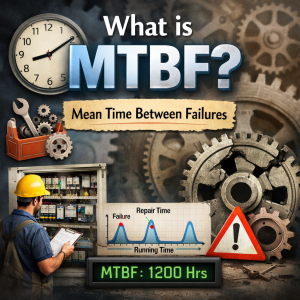
The reliability measurement system uses MTBF as a standardized metric, which calculates the average duration between equipment breakdowns. The system predicts the average operational period of a product until it experiences its first failure.
The durability of a product can be directly measured through this specific value. The MTBF value increases because there are fewer system failures that happen throughout the analyzed period.
Example:
- If MTBF = 500 hours
- A system is expected to run about 500 hours before failure
MTBF helps businesses:
- Compare product designs
- Evaluate vendors
- Assess component quality
It gives a clear, numerical view of reliability performance.
Why Is MTBF Important for System Reliability
System reliability refers to the probability of a system operating without failure during a given timeframe.
MTBF is crucial in determining this probability as it links actual data to the expected performance of the system.
Reliability Formula:
Reliability at time t = e^(−t / MTBF)
Here’s what that means in real life:
- If MTBF = 1,000 hours:
- After 1,000 hours, roughly 37% of systems are still working.
- At 500 hours, about 60% are still running.
This information helps businesses to:
- Forecast failures
- Estimate product lifespan
- Plan service strategies
MTBF serves as an essential metric that companies use to make decisions about their reliability engineering solutions investments.
How to Calculate MTBF
MTBF is computed through the use of a simple formula.
MTBF = Total Operating Time / Number of Failures
Here’s how to determine MTBF
- The first step requires you to calculate the total time spent on operations.
- The total operational time for your 10 machines equals 80,000 hours because each machine has operated for 8,000 hours.
- The next step requires you to document all the failures that took place.
There were 8 failures: - MTBF = 80,000 / 8 = 10,000 hours
- To recap:
- Greater MTBF indicates the equipment is more dependable.
- A smaller MTBF means a breakdown is more common.
Businesses should monitor MTBF over time to spot trends and assess whether things are improving.
Using MTBF for Product Design and Sourcing
MTBF is key in engineering and procurement decisions. It helps teams pick better components and build more reliable systems.
Applications in product design:
- Set minimum MTBF standards for components
- Compare different design options
- Lower failure rates early in the process
For example:
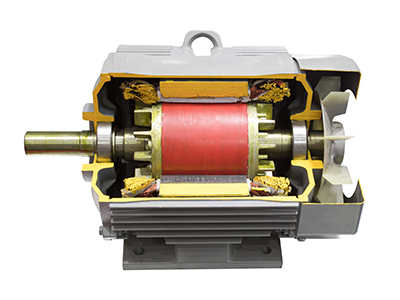
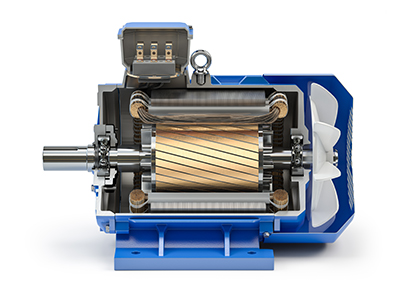
A company might require all motors to have:
- An MTBF of at least 20,000 hours
This ensures that the product lasts longer and minimizes warranty claims.
Benefits:
- Reduced cost of ownership
- Increased customer satisfaction
- Enhanced product performance
Engineering teams often use advanced reliability engineering software to simulate MTBF during design.
MTBF in Maintenance and Operations
MTBF is employed by maintenance teams to plan a preventive approach. It helps to avoid unexpected breakdowns.
Here’s how MTBF helps with maintenance:
- Plan inspections before failures happen
- Keep spare parts inventory optimized
- Cut down on unexpected downtime
Say:
Mean Time Between Failures is 10,000 hrs.
- Maintenance scheduling could be 5,000 to 8,000 hrs.
- This strategy assists in averting failures.
The benefits include:
- More system uptime
- Lower repair costs
- Improved resource planning
Organizations focused on reliability maintenance engineering depend a lot on MTBF data to improve their operations.
MTBF for Risk and Cost Management
MTBF provides valuable insights for financial and operational planning. It helps estimate how often systems may fail within a given timeframe.
Key business applications:
- Forecast annual failure rates
- Plan service contracts
- Allocate spare parts budgets
- Assess downtime risks
For instance:
A company that has 100 machines and its MTBF is 10,000 hours can estimate the failures per year.
This information can be used for:
- Budget Planning
- SLA Agreements
- Production Risk Analysis
Better MTBF insights enable better-informed decisions across different departments.
Strengths of MTBF
MTBF is still widely used as a popular measure of system reliability mainly because of its simplicity and utility.
Major advantages:
- Offers a clear single figure to understand easily
- Helps to compare different designs and products at a glance
- Helps to schedule maintenance
- Helps to forecast warranty and service cost
For example, consider this comparison:
- Product A: MTBF = 30,000 hours
- Product B: MTBF = 18,000 hours
Product A clearly has better reliability.
This clear difference makes MTBF useful when buying and evaluating products.
Limitations of MTBF
MTBF is advantageous; however, it is not without its limitations. Companies must understand these, so they can steer clear of making incorrect interpretations.
Here are the main limitations:
- It assumes failures happen at random.
- It doesn’t consider failures that happen early on.
- It overlooks the wear-out phase at the end of a product’s or system’s life.
One important point to keep in mind:
A critical perspective to keep in mind is that a system may have a very high MTBF and yet a poor performance if it takes a long time to repair it.
The discussion requires us to introduce MTTR as the next significant metric because MTTR stands for Mean Time To Repair.
So, MTBF shouldn’t be used by itself. It works best when combined with other reliability measures.
MTBF Across Different Industries
MTBF is used in many industries to boost reliability and lower risks.
Manufacturing:
- It helps keep production lines running longer without interruptions.
- It also reduces equipment breakdowns.
Aerospace:
- It ensures that safety-critical systems work reliably.
- It helps lower the risks involved in missions.
Automotive:
- Improve vehicle component durability
- Enhance customer satisfaction
IT and Data Centers:
- It helps keep servers running with little to no downtime
- It also prevents system outages.
Healthcare:
- It makes sure medical equipment works reliably.
- Avoid critical failure during operations
Each industry adjusts how it uses MTBF depending on its needs and how much risk it can accept.
Best Practices for Using MTBF
To get the most value from MTBF, businesses should follow structured practices.
Here are some recommended steps:
- The MTBF should be tracked continuously throughout all time intervals.
- The analysis of MTBF should be conducted together with both MTTR and availability measurements.
- The study requires you to use actual data instead of relying on hypothetical scenarios.
- The evaluation process requires assessment of MTBF data from multiple suppliers.
- Mean Time Between Failures (MTBF) should be an integral part of your product design and maintenance strategy.
The Strategic Role of MTBF in Reliability Engineering
MTBF is not just a technical metric. It plays a strategic role in business success.
It helps organizations to:
- Improve the quality of their products
- Lower operational risks
- Build greater trust with customers
- Cut lifecycle costs
At Dansob, we believe MTBF is a major factor that allows us to make engineering decisions more intelligently and guarantees that equipment will be working properly in the long run.
By making MTBF a part of their total reliability strategy, enterprises are capable of transforming the way they handle issues by changing from reaction to prevention.
Conclusion
MTBF provides a simple, standard way to measure reliability. It breaks down complex system behavior into useful insights you can act on.
But businesses should use MTBF together with other metrics to see the full picture. When used right, MTBF is a strong tool for design, maintenance, and making decisions.
At Dansob, we help organizations use MTBF and advanced reliability methods to create systems that work reliably in real-world situations.
FAQs
1. What does the term MTBF mean?
MTBF refers to Mean Time Between Failures. It is a measure of the average time that a system or a piece of equipment can operate continuously without breakdown.
- Why is MTBF important for businesses?
MTBF helps businesses estimate when failures might happen, schedule maintenance, and make systems more reliable.
- How do you calculate MTBF?
The system’s total operating time needs to be divided by its failure count to determine MTBF.
- Does a higher MTBF always mean better performance?
The situation does not work that way because high MTBF values indicate fewer system failures yet the repair duration affects total system efficiency.
- Can MTBF be used for all types of systems?
MTBF is primarily effective in the case of repairable systems where failures can happen and be rectified several times.