A product idea rarely fails because of a bad concept. It fails because the gap between concept and manufacturable reality was never properly closed; tolerances weren’t checked, and materials weren’t validated, in addition to other critical factors.
That is where mechanical engineering services step in, not as an outsourced task, but as the connective layer between an idea and a shippable product.
For manufacturers and product companies working under stiff budgets and shrinking timelines, knowing what these services actually do and how to evaluate the right mechanical engineering service partner has become a procurement priority, which we shall cover in this blog.
What Mechanical Engineering Services Actually Cover
The term is often used incorrectly, but in reality, it helps to separate the discipline into what it delivers across a product’s lifecycle.
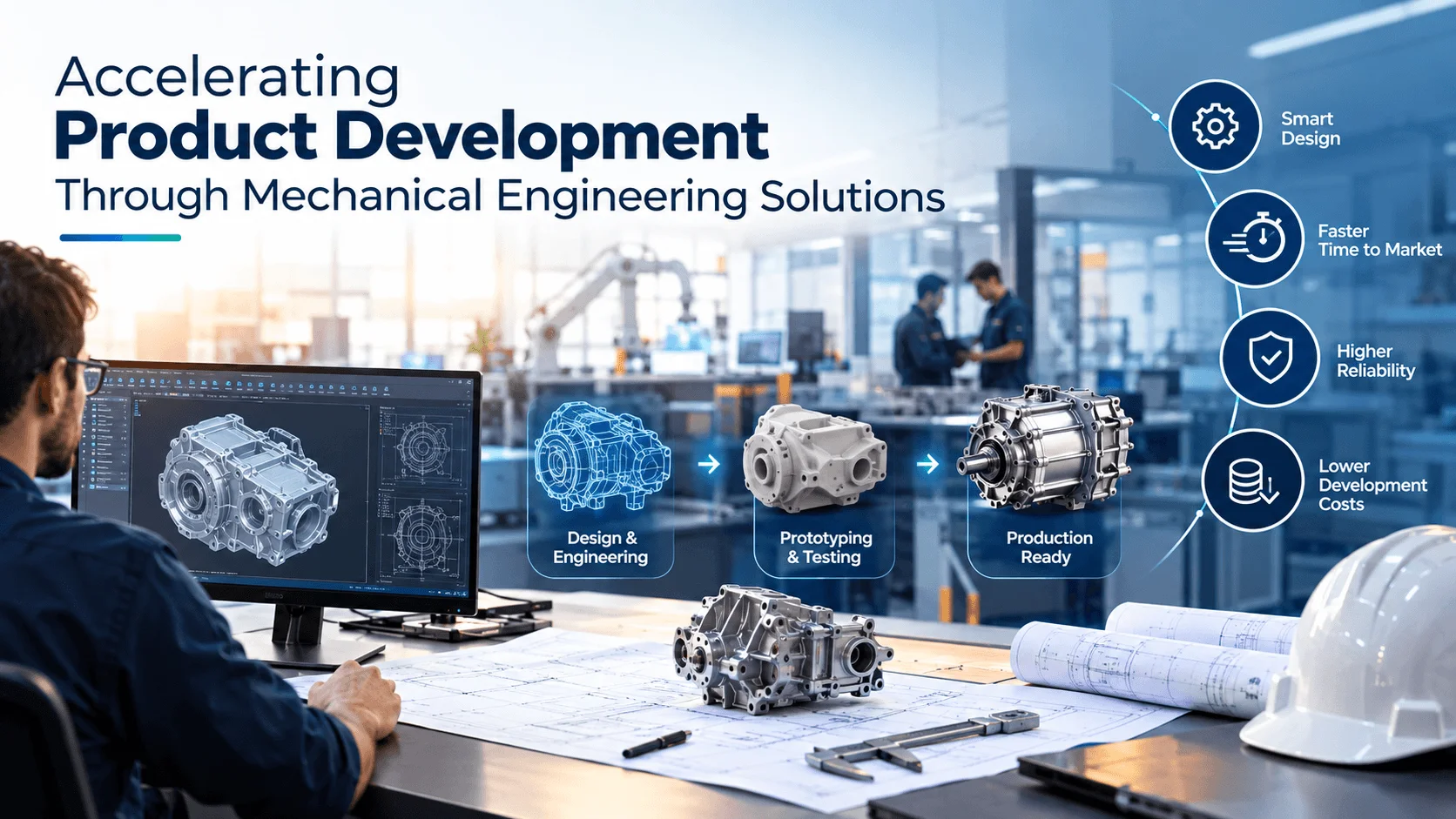
1. Design and Modeling
CAD-based concept development, 3D modeling, assembly design, and detailed drafting form the foundation of the mechanical engineering design. In these, geometry, fit, and function are worked out digitally long before the material is cut.
2. Analysis and Simulation
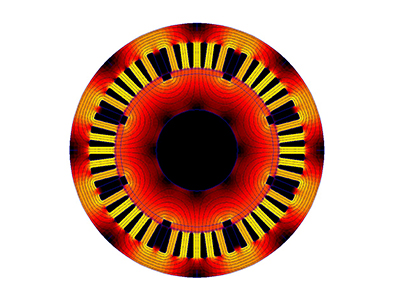
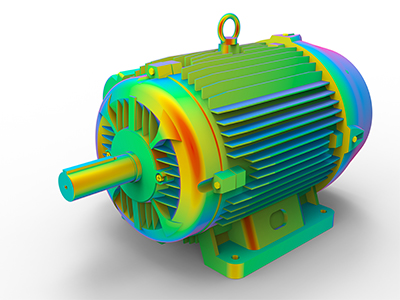
Finite Element Analysis (FEA), Computational Fluid Dynamics (CFD), thermal modeling, and fatigue or stress testing allow engineers to predict how a part behaves under varied load, heat, or vibrational conditions.
3. Design for Manufacturing (DFM) and Value Engineering
A part that looks fine on digital tools can still be expensive or nearly impossible to manufacture at large scale. Design for Manufacturing (DFM) review adjusts geometry, tolerances, and material choice so the design is production-ready, not just simulation-ready.
4. Prototyping and Validation
Rapid prototyping, whether 3D-printed, CNC-machined, or cast, gives teams a physical object to test against real-world scenarios before committing to tooling or full production.
5. Documentation and Compliance
Bills of Materials (BOM), technical documentation, and GD&T-compliant drawings aligned with ISO, ASME, or ASTM standards close the loop, ensuring a design can be consistently manufactured, audited, and maintained.
Why This Function Sits at the Center of Product Development
Market pressure constrains product development timelines. Below, we list the three factors that explain why mechanical engineering is a strategic foundation rather than a supporting element.
1. Complexity Has Increased Across Nearly Every Sector
Automotive components now integrate electronics, lightweight composites, and thermal management in a single assembly. Industrial equipment must precisely adhere to these performance specifications and energy-efficiency mandates. A generalist design team without sufficient expertise, expanded across multiple projects, often lacks the bandwidth to explore any single component on a deeper scale.
2. Rework Is the Single Biggest Cost Driver in Development
Design changes detected in the latter stages of the cycle, after the tooling process has started or a prototype has failed testing, could be highly expensive. To mitigate this challenge, engineering teams leverage front-load simulation and DFM review to identify these issues when a fix still means editing a CAD file rather than scrapping a mold.
3. Global Manufacturing Standards Are Not Optional
Products that need to be imported worldwide must comply with ISO, ASME, RoHS, REACH, or region-specific codes. Any non-compliance at the export stage not only stalls shipments but also damages client relationships. Building compliance into the design phase is the key to avoiding such pitfalls.
Where Specialized Mechanical Design Services Deliver Measurable Value
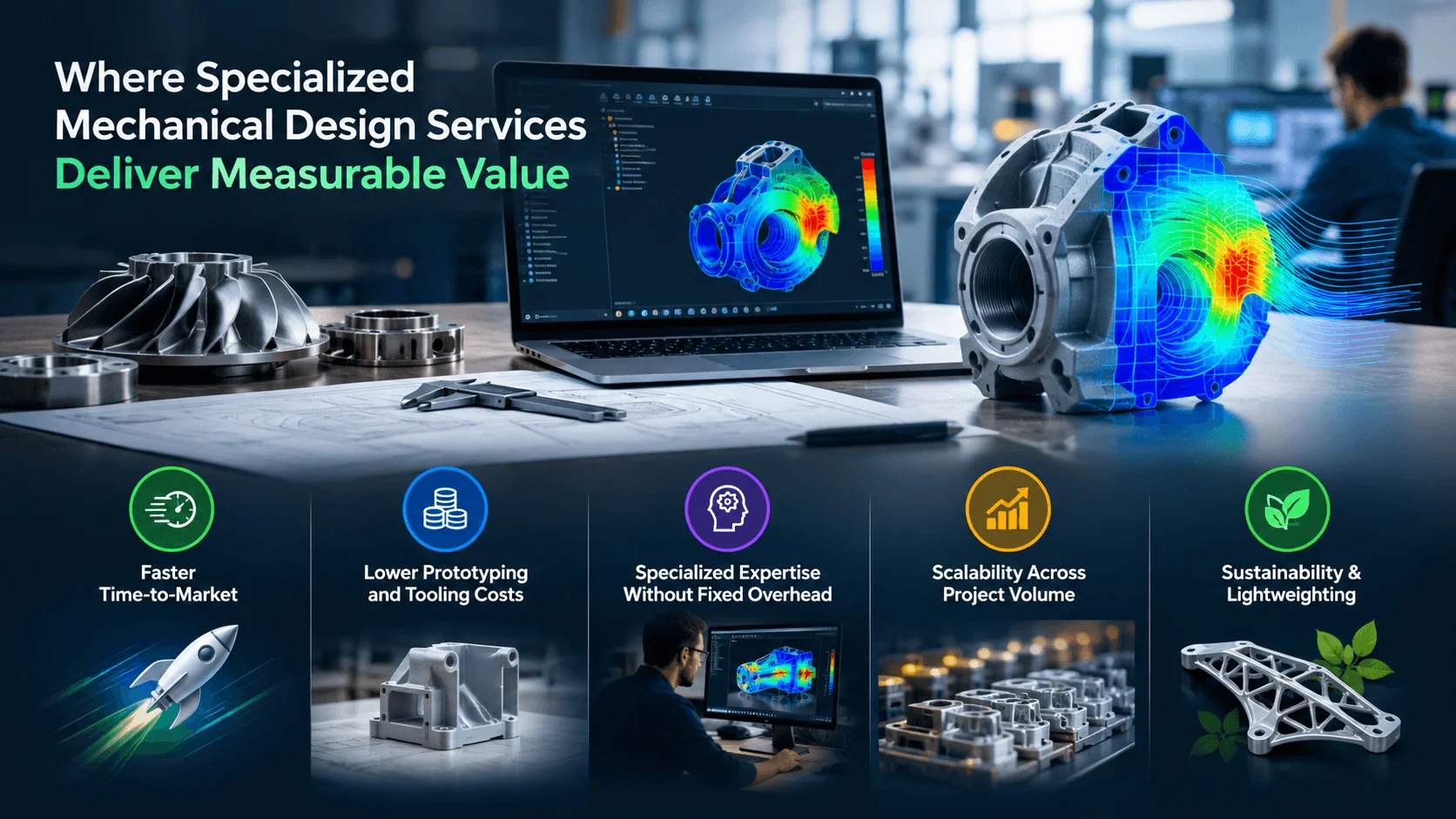
Organizations increasingly rely on specialized mechanical design services to improve engineering efficiency, reduce development risks, and create products that perform better throughout their lifecycle.
1. Faster Time-to-Market
Parallel workflows, in which engineering analysis, drafting, and DFM are executed concurrently rather than sequentially, shorten the timeline of a typical development cycle. Experienced mechanical engineering teams structure their process specifically to enable this overlap.
2. Lower Prototyping and Tooling Costs
Simulation-first design reduces the number of physical prototype iterations needed. Fewer iterations mean lower material spend, less machine time, and fewer schedule slips.
3. Access to Specialized Expertise Without Fixed Overhead
Not every manufacturer needs a full-time CFD specialist or a fatigue-analysis engineer on the payroll. Engaging an engineering service company for project-specific expertise avoids the cost of building and retaining that capability in-house.
4. Scalability Across Project Volume
Product pipelines rarely move at a consistent pace. A partner model absorbs volume spikes during a new product launch and scales down during slower periods, without the overhead of hiring and layoffs.
5. Sustainability and Lightweighting
Material substitution, lightweighting, and energy-efficient design are no longer niche requests. They are increasingly tied to both regulatory compliance and end-customer expectations, particularly in the automotive, aerospace, and industrial equipment sectors.
Choosing the Right Mechanical Engineering Services Company
For any business, the decision isn’t just about “who can model a part.” A few criteria separate a reliable development partner from a transactional vendor:
- Domain Depth: They possess vast experience in the specific sector (automotive, industrial, medical devices, or consumer products) rather than delivering generic CAD outputs.
- Simulation Capability: They maintain in-house FEA and CFD expertise by avoiding outsourced analysis that introduces additional handoffs.
- Compliance Track Record: They demonstrate familiarity with the standards relevant to the target market.
- Process Transparency: They have clear milestones, revision tracking, and a communication schedule, rather than a black-box delivery model.
- Tooling and Software Fluency: They are proficient in designing tools like SolidWorks, CATIA, Creo, and ANSYS to ensure smoother integration with the existing engineering stack.
Dansob’s Strategic Approach to Mechanical Engineering Challenges
Dansob works across the full product development cycle, from early concept modeling and simulation to DFM review, prototyping support, and compliance‑ready documentation. Our focus remains on reducing the number of handoffs between design and manufacturing, since each handoff leads to undue delays and miscommunication.
Furthermore, rather than treating mechanical engineering as a one-time drafting task, the approach is built around iterative validation: detecting design flaws through simulation before they reach the prototype stage and structuring documentation so it holds up under both internal review and external audits.
Conclusion
Mechanical design solutions have evolved from a back-office function to a driver of the speed and reliability of products reaching the market. The organizations gaining ground are those that treat design, simulation, and compliance as a single continuous process rather than three separate handoffs.
Whether the goal is to reduce prototyping costs, meet a regulatory deadline, or simply avoid rework, the right mechanical engineering partner can change the trajectory of the entire product development timeline.
Dansob, among the leading mechanical engineering service providers, has delivered efficient results with our team of highly skilled mechanical engineering professionals. We analyze your project from the ground up and provide tailored solutions that precisely align with your sustainability goals. Consult our team to begin this transformative journey.
FAQs
- What Do Mechanical Engineering Solutions Mainly Cover?
They cover the design, simulation, validation, and documentation stages of product development, ranging from initial CAD modeling to FEA testing, prototyping, and manufacturing‑ready drawings.
- How Do Mechanical Engineering Design Solutions Reduce Product Development Costs?
This can be achieved by detecting design flaws in the early stages through simulation before physical prototyping begins. Moreover, our team avoids expensive late-stage rework and reduces the number of prototype iterations.
- What Industries Rely Most on Mechanical Engineering Solutions?
Automotive, aerospace, industrial equipment, consumer electronics, energy, and medical device manufacturing are among the key sectors that rely on mechanical engineering solutions due to their compliance requirements and design complexity.
- How Long Does a Typical Mechanical Design Project Take?
The exact timelines vary by scope. Broadly, most projects range from a few days for isolated drafting tasks to several months for full product lifecycle support, including simulation, prototyping, and documentation.
- What Should an Organization Look for in a Mechanical Design Services Company?
They should seek sector-specific experience, in-house simulation capability, a clear compliance track record, transparent project workflows, and strong data security practices in a mechanical design services company.