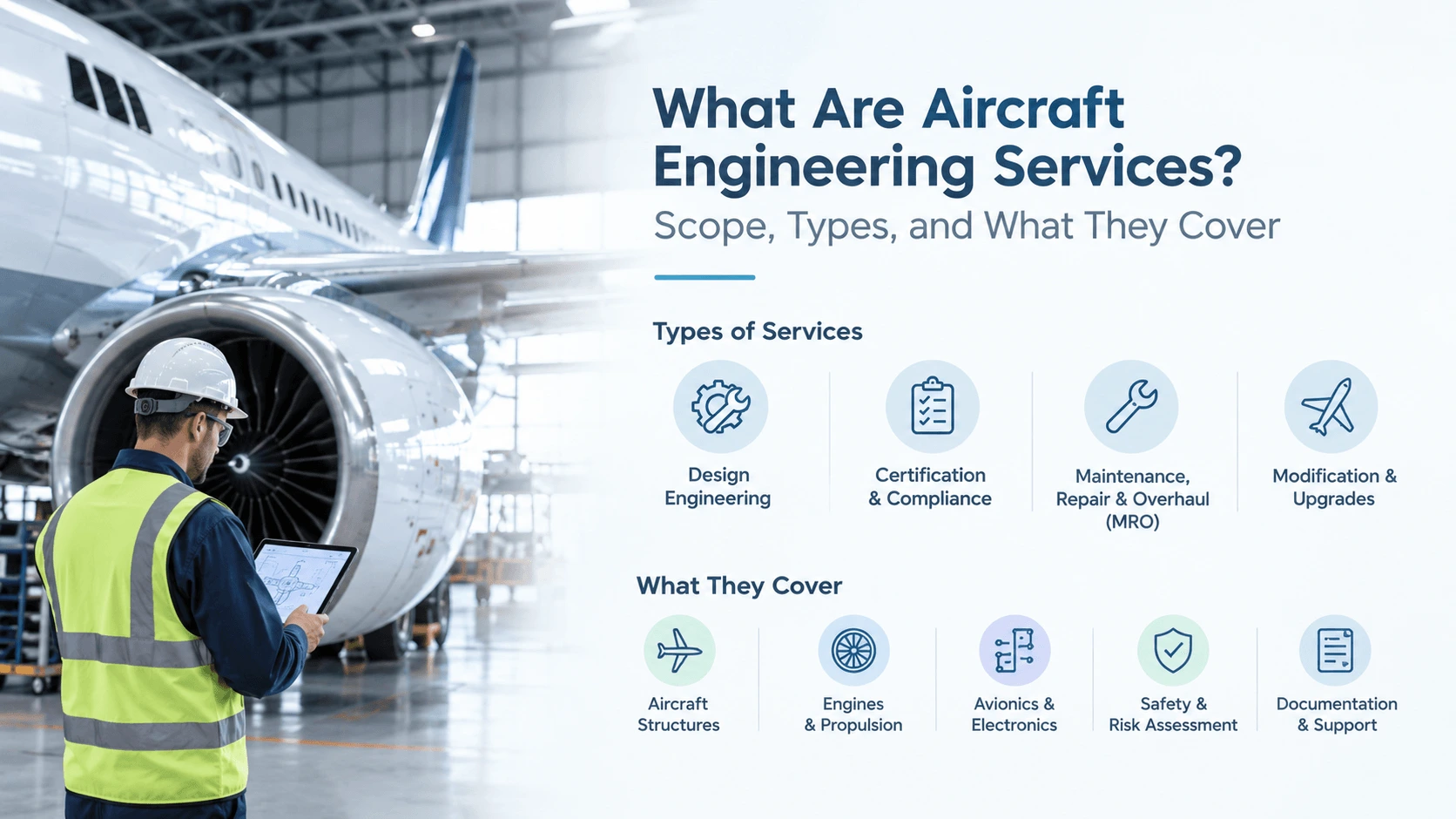
Aircraft Engineering Services encompass the highly specialized technical, analytical, and design solutions required to develop, manufacture, maintain, and upgrade aerospace systems. Because modern aviation demands absolute safety, efficiency, and stringent regulatory compliance, these professional solutions bridge the gap between complex theoretical physics and real-world fleet operations.
The baseline commercial scale of this sector is immense; the global aerospace engineering services outsourcing market size is valued at $133.65 billion, expanding at a compound annual growth rate (CAGR) of 19.8% [1]. This rapid scaling is heavily driven by increasing aircraft complexity, massive production order backlogs, and aggressive digital transformation across original equipment manufacturers (OEMs). To optimize baseline overhead and access global talent pools, major aerospace OEMs now systematically outsource a portion of their core design, simulation, and hardware validation workflows to dedicated technical partners [2].
From commercial airliners to defense-sector assets, dedicated aerospace technologies solutions ensure that an aircraft remains structurally sound, aerodynamically optimized, and technologically current throughout its entire operational lifecycle. This lifecycle support is deeply critical given that high-value design, prototyping, and component-level simulation tasks now routinely account for roughly 30% to 45% of active global aerospace engineering contracts [3], while the global demand for new commercial and cargo aircraft continues to put massive structural optimization pressure on legacy assemblies [4].
The Scope of Aircraft Engineering Services
The application of aircraft engineering is distributed systematically across the entire operational lifespan of an airframe, categorized into three core phases:
-
Research, Development, and Design:
The initial phase focuses on clean-sheet design and architectural optimization. Comprehensive design services leverage Computational Fluid Dynamics (CFD) and high-fidelity simulation arrays to establish aerodynamic profiles, optimize lifting surfaces, and test alternative propulsion integrations before physical prototyping begins.
-
Manufacturing and Systems Engineering:
This lifecycle stage bridges the gap between raw engineering blueprints and scalable industrial assembly. It relies heavily on advanced modeling & drafting to construct the tooling, computer-aided manufacturing (CAM) workflows, automated riveting/welding paths, and quality control protocols that ensure absolute structural uniformity across production runs.
-
In-Service Support and Continuing Airworthiness:
Post-delivery engineering focuses on maximizing airframe uptime and managing structural aging. Engineering teams monitor real-world flight data, perform structural fatigue diagnostics, and architect physical modifications or cabin reconfigurations required to extend the economic life of operational aircraft.
Core Types of Aircraft Engineering Services
Modern aerospace architectures are highly interconnected networks of mechanical, structural, and digital subsystems. Accordingly, aircraft engineering services are segmented into distinct technical disciplines.
Aerostructures and Structural Mechanics
Aerostructural engineering ensures the physical integrity of the primary lifting body, fuselage, and landing gear assemblies under extreme dynamic loads. Using rigorous mechanical engineering principles, engineers analyze complex stress fields, shear distributions, and buckling limits to optimize the strength-to-weight ratio of the vehicle.
Engineers deploy advanced Finite Element Analysis (FEA) solvers to discretize physical airframes into mathematical nodes. This allows for the precise evaluation of localized stress concentrations, cyclic fatigue limits, and thermal expansion effects experienced during high-altitude operations and hard landing impacts.
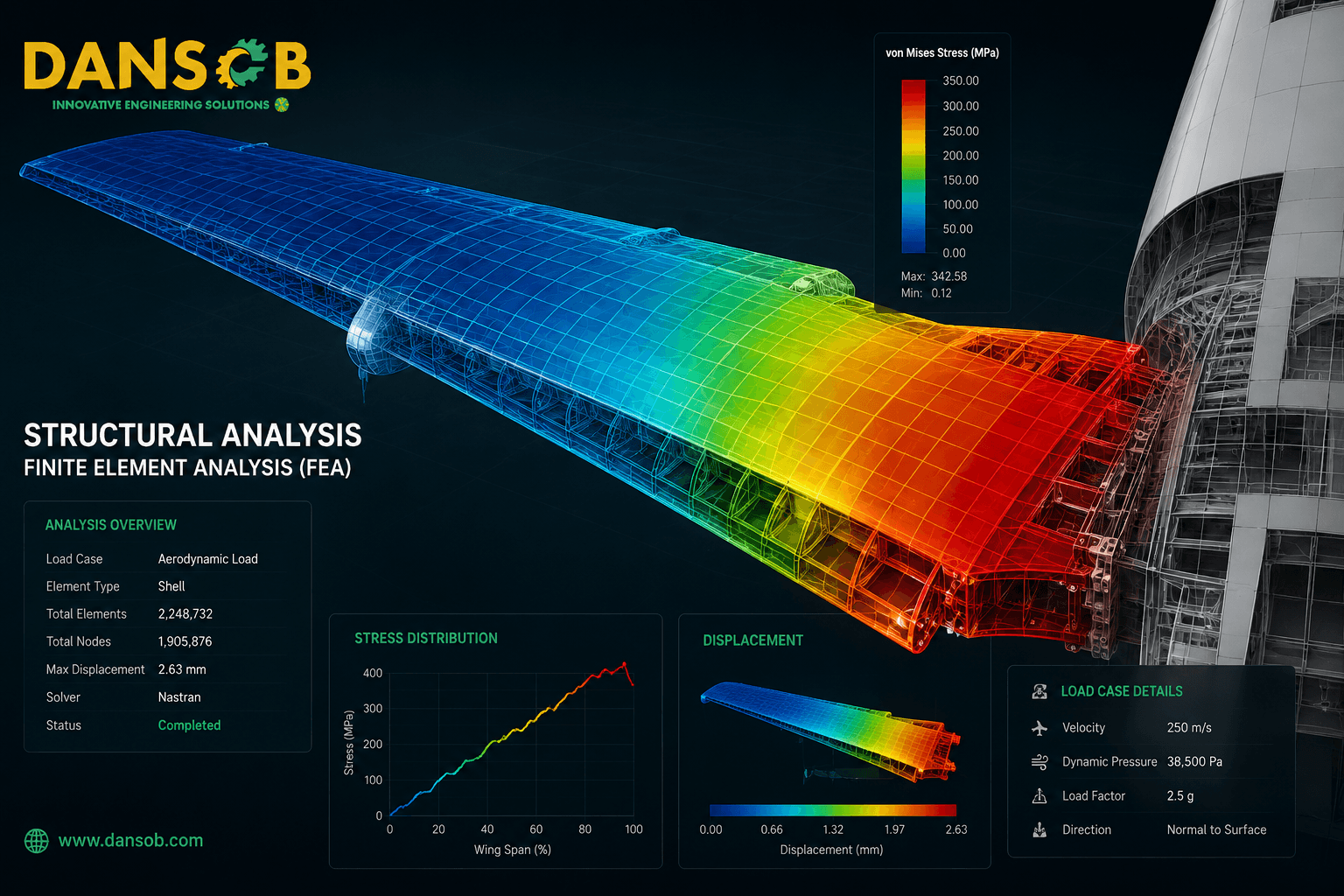
This discipline also dictates the transition from traditional aerospace aluminum alloys to advanced carbon-fiber reinforced polymers (CFRP) and titanium matrices. Engineers calculate fiber orientation sequences and resin curing profiles to achieve maximum torsional rigidity while cutting dead weight.
Avionics, Control Laws, and Electrical Architectures
Avionics engineering represents the central nervous system of modern aircraft, governing flight control logic, navigation sensor fusion, and situational awareness arrays.
Engineers author and validate deterministic software code responsible for fly-by-wire (FBW) flight characteristics. This involves programming stability augmentation algorithms and flight envelope protection limits to ensure safe aerodynamic handling under severe atmospheric turbulence.
Managing high-voltage power generation is another vital capability. Systems are planned utilizing advanced electrical engineering practices to ensure vast electrical loads are safely conditioned and routed across the aircraft’s main power grid.
Propulsion Integration and Aerothermodynamics
Propulsion engineering governs the mechanical and thermodynamic interfacing between the powerplant (turbofan, turboprop, or open-rotor systems) and the airframe structure.
Engineers design the structural pylons and engine cowlings (nacelles) to withstand immense thrust loads, torque deflections, and engine-out vibration profiles while minimizing localized aerodynamic drag and boundary-layer separation.
This domain also covers the layout of complex fuel routing networks, detailing tank venting, cross-feed valve plumbing, center-of-gravity fuel management schemes, and high-pressure delivery systems designed to eliminate cavitations or vapor-lock anomalies.
Environmental Control and Subsystem Fluids
Fluid dynamics engineers manage internal cabin environments and the critical auxiliary power loops required for sub-component actuation. This directly relies on deep analyses services to ensure all fluid behaviors meet target operational tolerances.
This focuses on high-pressure fluid systems—such as 3,000 to 5,000 PSI hydraulic circuits used to actuate primary flight control surfaces and landing gear, as well as pneumatic bleed air loops routed for engine anti-icing.
For high-altitude and military operational profiles, specialized environmental control systems (ECS) are mandatory to sustain human life. This sub-specialty dictates the integration of life-support technologies such as the onboard oxygen generating system (OBOGS), which filters ambient bleed air through molecular sieves to deliver breathable oxygen to flight crews.
Aerospace Program Managers & Engineering Directors
Accelerate your platform’s development timeline. Dansob Inc. delivers end-to-end design services and rigorous analyses services tailored for safety-critical civilian and defense aviation architectures. Partner with Dansob’s Systems Engineering Team today.
What Do These Services Cover?
When an aerospace company or defense entity hires an external service provider, they are typically looking for specific, highly regulated deliverables. These usually include:
-
Aviation Regulatory Compliance & Certification: Preparing data packages for aviation authorities (like the FAA or EASA) to achieve Type Certifications or Supplemental Type Certificates (STCs) for complex modifications.
-
Fleet Technical Management: Developing customized reliability programs, analyzing line maintenance data, and conducting thorough maintainability engineering assessments to draft optimized Maintenance Planning Documents (MPDs).
-
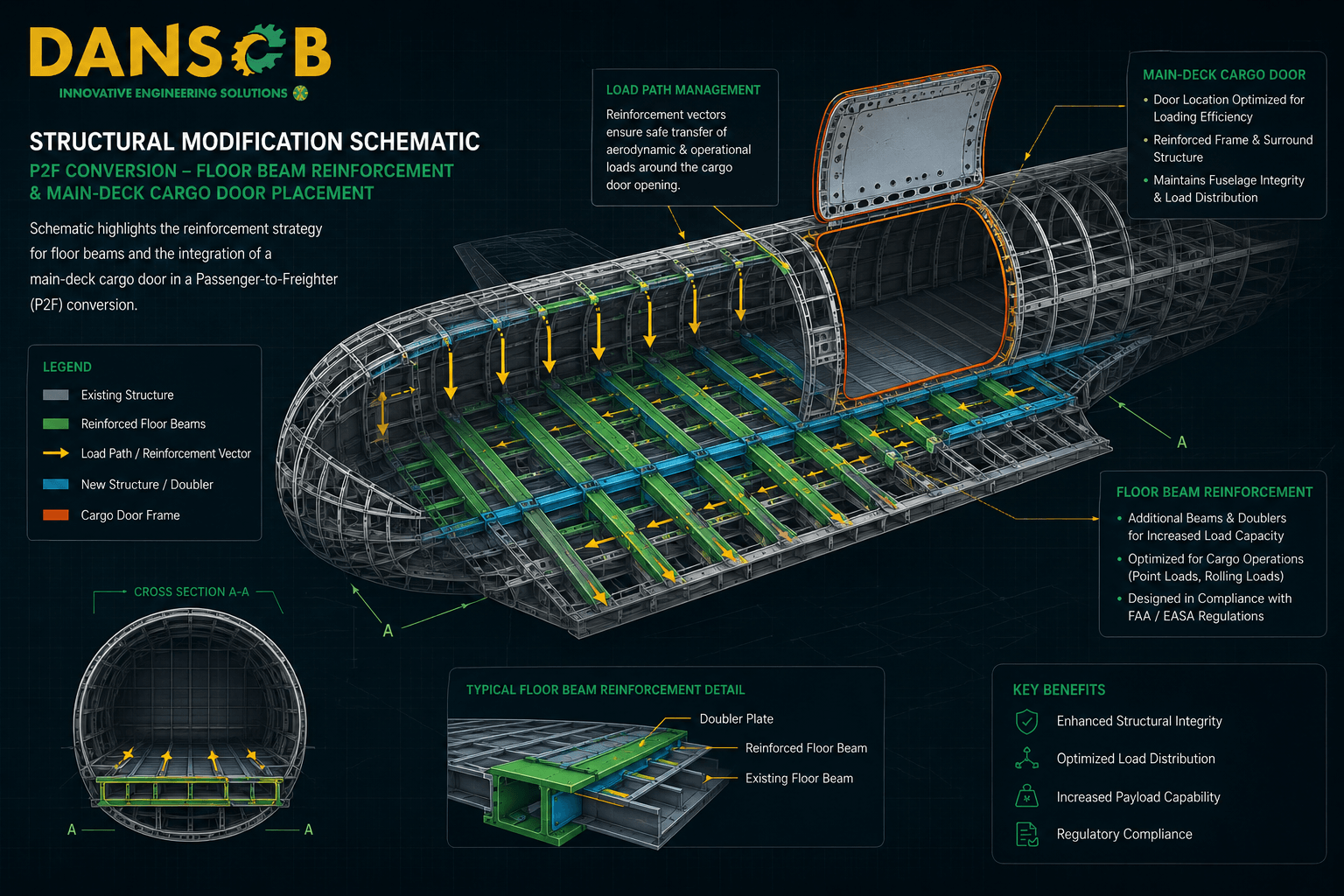
Cabin Retrofits & Passenger-to-Freighter (P2F) Conversions: Engineering solutions to completely strip an old passenger aircraft and rebuild it as a cargo carrier. Passenger seating arrangements exert uniform, low-density loads on an airframe. Converting an aircraft to haul heavy freight requires engineers to completely redesign the lower fuselage floor structures, introducing heavy-duty titanium floor beams to handle localized cargo pallet loads.
Additionally, cutting a massive aperture into a pressurized fuselage permanently disrupts original load distribution paths. Engineers must design robust structural surround frames around the main cargo door to redistribute torsional loads and prevent catastrophic hull decompression during cabin pressurization cycles.
-
System Safety Frameworks & Prognostics: Mitigating operational risk requires a clear, codified system safety engineering process workflow to run quantitative diagnostics on interconnected flight hardware. By pairing real-time IoT sensor telemetry with structural math models, engineering teams construct virtual twins of operational airframes. These twins run continuous simulations to predict localized component wear, transforming traditional schedule-based operations into highly precise predictive maintenance frameworks.
Ultimately, Aircraft Engineering Services provide the highly regulated intellectual capital required to keep the global aviation industry moving safely forward. By embedding continuous system safety verification from baseline design to full lifecycle modifications, these services remain the unsung heroes of aviation safety and innovation.
Frequently Asked Questions
Q1: What is the operational boundary between aircraft engineering services and MRO operations?
Aircraft engineering services encompass analytical, design, stress modeling, and regulatory compliance workflows—such as designing repairs or securing STC approvals. Conversely, MRO (Maintenance, Repair, and Overhaul) defines the hands-on mechanical execution team that physically performs inspections, applies engineering repairs, and handles hardware replacements on the aircraft.
Q2: What engineering metrics define a successful Passenger-to-Freighter (P2F) conversion?
A successful P2F conversion is defined by structural load path integrity, longitudinal shear strength of the newly reinforced cargo floor grids, and maintaining structural torsion resistance after cutting the main fuselage cargo door aperture, ensuring the platform handles high-density cargo without adding excessive empty weight.
Q3: How do aircraft engineering services directly support FAA and EASA certification paths?
Engineering providers compile the formal data packages required by aviation authorities, executing deterministic structural analyses, flight test telemetry evaluations, and environmental tolerance testing to secure Supplemental Type Certificates (STCs) or full Type Certifications.
Q4: How does Finite Element Analysis (FEA) mitigate in-service structural failures?
FEA isolates complex airframe geometries into discrete mathematical nodes, allowing engineers to simulate structural stress, aerodynamic loading, and cyclic thermal variation. This process highlights hidden stress concentrations and micro-fatigue failure points before components undergo physical cracking.
Q5: What technical challenges do Airworthiness Directives (ADs) present to engineering services?
When an aviation authority issues an AD regarding a systematic safety flaw, engineering services must immediately analyze the mechanical defect, cross-reference it with the operator’s specific tail-number configurations, and engineer an authorized modification or physical repair scheme to restore compliance.
Q6: How does the More Electric Aircraft (MEA) trend change legacy fluid power engineering?
The MEA trend systematically replaces traditional central hydraulic lines and pneumatic engine bleed air loops with decentralized high-voltage electrical distribution networks. This requires engineers to shift focus toward advanced power electronics, electro-hydrostatic actuators (EHAs), and dedicated liquid-cooling thermal management systems.
Updated References:
[1] Aerospace Engineering Services Outsourcing Global Market Report, Research and Markets.
[2] Aerospace Engineering Services Outsourcing Market Size & Share Report, Grand View Research.
[3] Aerospace Engineering Services Outsourcing (ESO) Market Dynamics, Future Market Insights.
[4] Global Aerostructures Market Size & Growth Report, Grand View Research.